How Safe Is Auto Transport, Really?
This is the question every first-time shipper asks, and the honest answer is: extremely safe. The industry-wide damage rate for professionally transported vehicles is well under one percent. For context, the statistical likelihood of damage driving your vehicle cross-country on a busy interstate highway — road debris, distracted drivers, weather hazards, fuel stops with tired drivers — is meaningfully higher than the damage rate for professional carrier transport. Your car spends most of its transit time secured to a trailer, not navigating road hazards.
That said, "safe" doesn't mean "zero risk." Understanding where the real risks exist — and how to protect against them — is the difference between a shipper who is prepared and one who is caught off guard by a situation they didn't anticipate.
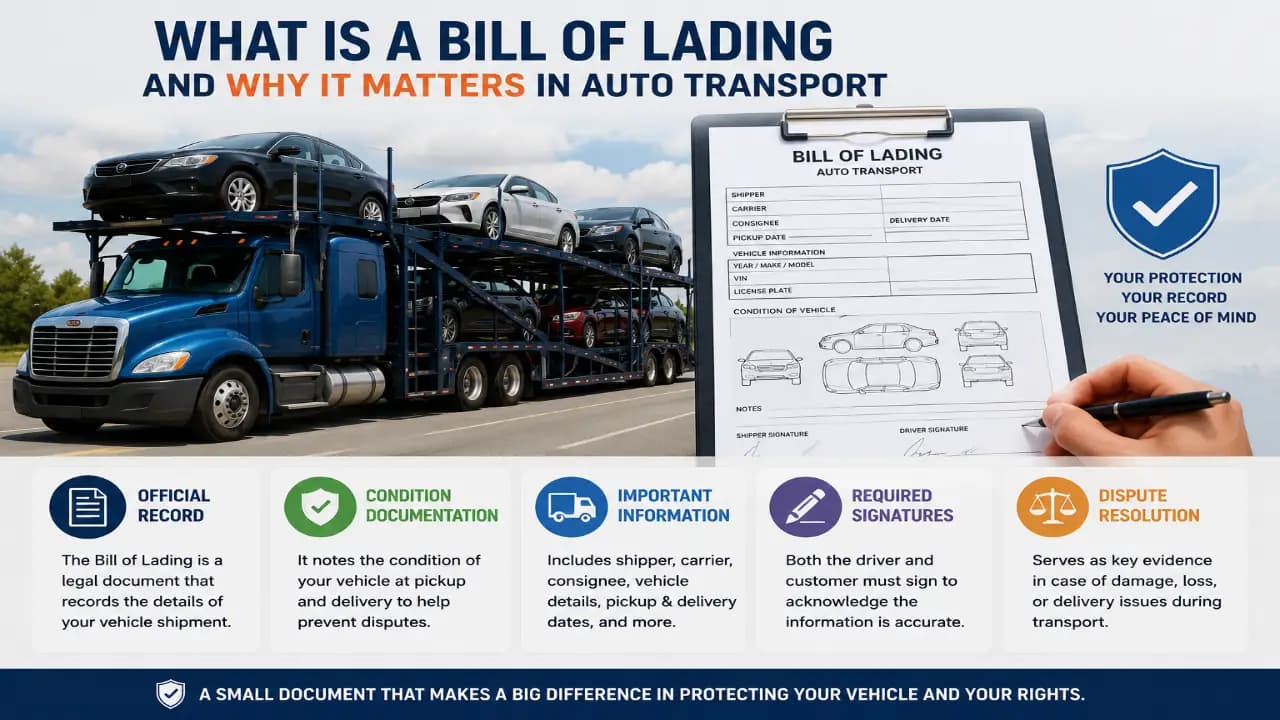
The Bill of Lading: Your Safety Net
The single most important safety mechanism in auto transport is not insurance — it's the Bill of Lading (BOL). This document created and signed at pickup and at delivery serves as your legal record of your vehicle's condition at both points. A BOL executed with meticulous condition documentation is the foundation of any successful damage claim and the primary tool for distinguishing transport damage from pre-existing conditions.
At pickup, conduct a systematic inspection: start at the front bumper and work clockwise around the entire vehicle. Check every panel, the roof, all door jambs, the undercarriage if possible, and both bumpers. Document every existing blemish, no matter how minor. The driver should be doing the same — if they aren't being thorough, prompt them. Every scratch noted on the pickup BOL is excluded from any future damage claim, which benefits both parties by creating a clear, unambiguous record.
Physical Security During Transit
Modern car hauler trailers use hydraulic multi-level decking systems that adjust height to clear overhead obstructions. Your vehicle is secured to the trailer deck using wheel net or strap tie-down systems, preventing any movement during transit. DOT regulations require minimum strap ratings for the weight class of vehicle being secured, which licensed, compliant carriers follow as a matter of law.
The most common source of minor transport damage — stone chips from road debris — is an inherent risk of open carrier transport, the same as highway driving. The frequency is drastically lower than driving (your car isn't operating at highway speed, the chips come from other vehicles on the road passing the carrier), but it is nonzero. For vehicles where any paint disturbance is unacceptable, enclosed transport physically eliminates this exposure by sealing the trailer.