Insurance Is Non-Negotiable in Auto Transport
Federal law (FMCSA regulations, 49 CFR Part 387) requires that every licensed motor carrier maintain minimum levels of cargo insurance to operate legally in the United States. This is not optional, and it is verifiable. Before you hand your keys to any transport driver, you can and should confirm that the carrier has an active, adequate cargo insurance policy in place. A Certificate of Insurance is a standard document that any licensed carrier can provide instantly, for free, on request.
Most damage claims against auto transport carriers arise not from spectacular accidents but from the mundane realities of road transport: a rock chip from a highway debris strike, a scratch from an improperly cinched tie-down strap, a dent from a loading ramp contact. Understanding how the claims process works before your vehicle is ever loaded is the single most important preparation you can make.
What Carrier Insurance Actually Covers
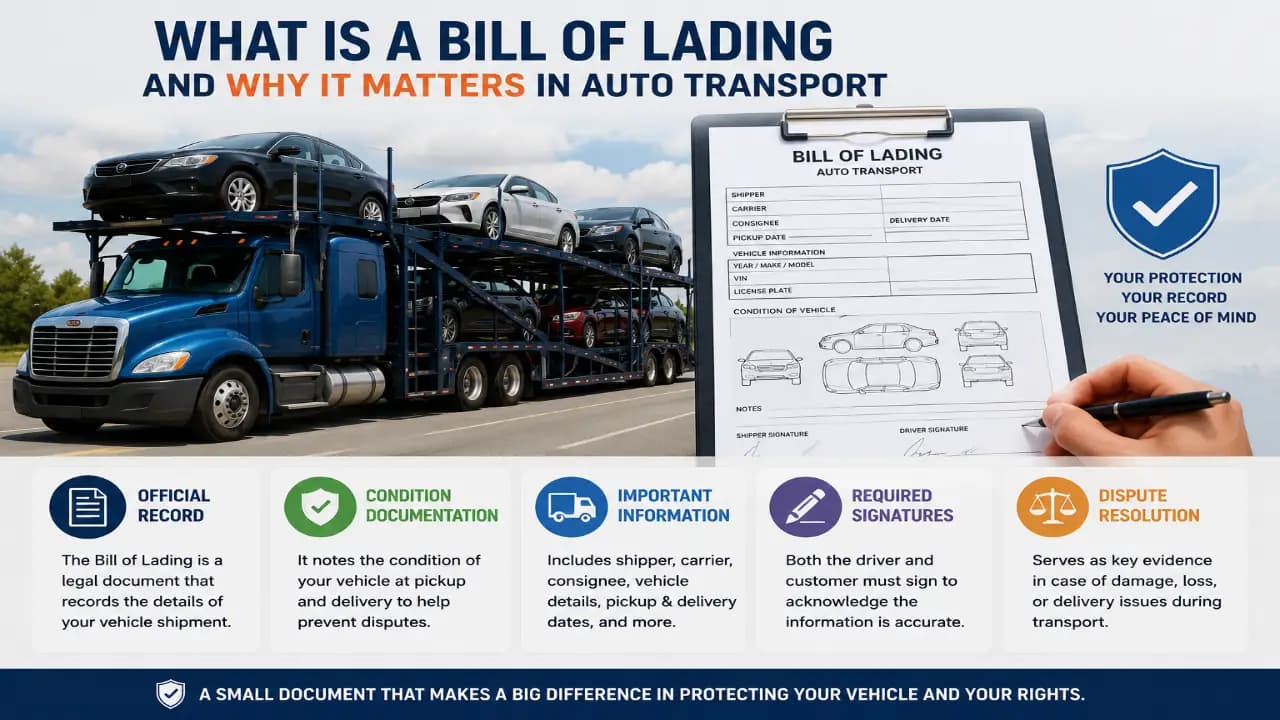
Carrier cargo insurance covers physical damage to your vehicle that occurs during the period the carrier has custody of it — from the moment the driver takes the keys at pickup to the moment you (or your representative) signs the delivery Bill of Lading. Coverage typically includes damage caused by road accidents, improperly secured vehicle movement during transit, and loading/unloading incidents.
What carrier insurance does not cover is equally important to understand. Pre-existing damage is always excluded — which is why the pickup inspection and BOL documentation are so critical. Acts of nature (hailstorms, flooding, earthquake damage during transit) are frequently excluded or subject to higher deductibles. Mechanical failures — a battery that dies, a tire that goes flat — are generally not covered because they're considered the vehicle owner's maintenance responsibility. Personal items left inside the vehicle are almost never covered by cargo insurance.
The Bill of Lading: Your Primary Insurance Document
The Bill of Lading (BOL) is the legal document that records your vehicle's condition at pickup and at delivery. It is the foundation of any damage claim. At pickup, both you (or the seller, if you're buying a car online) and the driver document every existing scratch, dent, chip, and blemish. Both parties sign. At delivery, you compare the current condition to the pickup record.
If the delivery inspection reveals new damage not present on the pickup BOL, you note it specifically on the delivery BOL before signing and before accepting the vehicle. This creates documented, signed evidence that the damage occurred during transport. If you sign a clean delivery BOL (stating the vehicle arrived in good condition) before discovering damage, you have almost no recourse — legally, your signature constitutes acceptance of the vehicle's condition at that moment.
Supplemental Insurance for High-Value Vehicles
Standard carrier insurance has per-vehicle coverage caps that may be insufficient for high-value vehicles. A carrier's policy might cap at $100,000 per vehicle — more than adequate for a $35,000 daily driver, but inadequate for a $180,000 Porsche GT3 RS or a classically restored muscle car with documented appraisal value of $250,000.
Supplemental cargo insurance is available through both specialty transport companies and third-party insurance providers. If you're shipping a vehicle worth more than the carrier's stated coverage cap, supplemental coverage is a sound investment. The premium is typically a fraction of a percent of the vehicle's stated value, and it removes the financial risk of a gap between actual damage and carrier coverage.
Filing a Claim: What the Process Actually Looks Like
If you discover damage at delivery and properly document it on the BOL, the claims process begins. You'll contact the carrier (not the broker — the actual motor carrier company responsible for your shipment) and file a written claim within the timeframe specified in your contract (typically 9 months as per Carmack Amendment regulations for interstate shipments). You'll submit your BOL documentation, the pre-shipping photo record, any delivery photos, and a repair estimate from a qualified body shop or mechanic.
From that point, the carrier's insurance adjuster evaluates the claim. Common resolution timelines range from 30 to 90 days. Having clear, timestamped photographic evidence before and after shipping dramatically accelerates this process. Claims without adequate documentation — where there's legitimate ambiguity about whether damage was pre-existing — take longer and are more frequently disputed.