How to Choose the Right Car Shipping Company and Avoid Costly Mistakes

Table of Contents
- Why Your Choice of Car Shipping Company Matters More Than You Think
- Start With Licensing — Then Everything Else
- How to Actually Read the Reviews
- Why the Lowest Quote Is Almost Always a Trap
- What Every Legitimate Quote Should Include
- Insurance: The Fine Print That Actually Matters
- Open vs Enclosed Transport: How to Match the Service to the Car
- Delivery Windows, Contracts, and What Not to Sign
- Vehicle Prep and the Two Inspections Most People Skip
- The Mistakes That Kill Otherwise Solid Shipments
- Why Customers Book Their Auto Transport Through Furious
- FAQs
- Book Your Shipment With Confidence
The car shipping industry has a trust problem. Thousands of brokers hold identical FMCSA licenses and run nearly identical websites, all promising the same five-star nationwide service. Behind those websites, some are seasoned logistics operators. Others are one person with a laptop, hoping the driver they subcontracted actually shows up.
Picking the wrong one can cost you the price of the shipment plus another $500 in delays, damage, or lost workdays. Picking the right one makes the whole thing forgettable — which is exactly what you want from a car shipment.
We wrote this because we’ve dispatched more than 50,000 vehicles across the country since 2015, and we’ve seen every angle of what makes a good shipment go bad and a bad broker look convincing. If you’re evaluating providers and want to land with the Auto Shipping Across the US for your specific situation, here’s how we recommend you do it.
Why Your Choice of Car Shipping Company Matters More Than You Think
Most customers assume auto transport is a commodity — pay the price, get the shipment. In practice, the broker you pick controls almost everything that happens after the deposit clears:
- Which specific carrier gets your car
- Whether that carrier’s FMCSA safety score is current (scores change monthly)
- Whether you get a named dispatcher or a call-center rotation
- How fast pickup happens after booking
- Whether the quote you approved is what actually shows up on the driver’s paperwork
In our experience, the difference between a smooth cross-country shipment and one that turns into a two-week saga usually isn’t the driver. It’s the broker’s vetting standards and how tightly they run dispatch.
Some brokers post loads to public boards and let any registered driver take them. Others (including us) run a closed carrier pool and vet every driver before they ever see your load. Both approaches are legal. Only one gives you real accountability if something goes sideways.
Start With Licensing — Then Everything Else
Any broker offering interstate transport in the US must hold three things:
- An active USDOT number
- FMCSA broker authority (with an “MC” prefix)
- A $75,000 broker surety bond filed with FMCSA
You can verify all three in about ninety seconds. Go to safer.fmcsa.dot.gov and look up any broker by their MC number. The record shows authority status, insurance filings, and bond status. If any flag reads “inactive” or “revoked,” walk away. It doesn’t matter how good the price is.
One nuance most customers miss: a broker holding active authority isn’t the same as a broker actively enforcing carrier vetting. Anyone can hold a license. Whether they check the carrier they hand your car to is a separate question — and one FMCSA doesn’t audit. Ask any broker directly: what’s your carrier acceptance rate, and how often do you re-check safety scores? A real answer tells you a lot.
How to Actually Read the Reviews
Reviews are noisy. Every broker has some five-star reviews and some one-star reviews. What matters is the shape of the pattern, not the individual stories.
- Skip the five-star reviews from the first 90 days after a company was founded. These are almost always seeded.
- Read the three-star and four-star reviews first. These are usually the most honest — customers who got what they paid for but noticed rough edges.
- Look for the same word in five different one-star reviews. “Rescheduled,” “no answer,” “hidden fee” — if it appears repeatedly, it’s a pattern, not one bad shipment.
- Cross-check on BBB, Google, and TransportReviews.com. A broker with 4.9 stars on their own site and 2.1 on BBB is telling you something important.
We tell our own customers to read our BBB profile before they book, not our website testimonials. Testimonials are curated. BBB and Google reviews aren’t.
Why the Lowest Quote Is Almost Always a Trap
The auto transport market has a specific type of dishonesty called “lowballing.” Here’s how it works. A broker gives you a quote that’s $200 below market. You book. They pocket the deposit. Then they post your load to a national load board at a price so low no experienced driver will take it. Your pickup date passes. They call and say “unfortunately carrier rates have gone up — we need $250 more to dispatch.” By then you’ve committed your schedule around the pickup, so you pay.
The specific tell: any quote significantly below the market rate on your lane. If our system prices a Chicago-to-Dallas shipment at $850–$1,050 and another broker quotes $700, one of two things is true. Either they’re planning to raise the price later, or they’ll dispatch to whichever carrier accepts the low rate, which is usually the least experienced one on the load board.
Transparent pricing means the number on the quote is the number on the final invoice. It also means the price reflects what a professional driver actually needs to run the route safely. That protects your car, your schedule, and your patience.
What Every Legitimate Quote Should Include
Ask for a written quote before you pay anything. It should show:
- Total shipment price, all-in
- Deposit amount and when it’s charged
- Balance due at delivery and how it’s paid
- Transport type — open auto transport or enclosed auto transport
- Pickup window (usually 1–5 days)
- Estimated transit time
- Cancellation policy in writing
If a broker won’t put those details in a document you can save, that’s a red flag. A shipment quote that only lives in a phone conversation gives you nothing to hold them to later.
Insider caveat: even a written quote can be legitimately re-negotiated by the driver at pickup — if you didn’t disclose a lift kit, extra ground clearance, or more personal items than declared. Legitimate. What isn’t legitimate is the broker calling to raise the price because “carrier rates went up.” Those are two different scenarios, and the second is the lowballing scam described above.
Insurance: The Fine Print That Actually Matters
Every FMCSA-registered carrier is required to hold cargo liability insurance. The amount varies. The important question isn’t “are you insured” — every legitimate operator is. The important questions are:
- How much cargo liability is on the specific carrier you’re dispatching? Ask for the policy limit in writing.
- What’s the deductible? If it’s $2,500, small damage claims may cost more to file than the repair itself.
- Does the policy cover undercarriage damage? Some don’t. Damage from road debris under the car is a common claim.
- Who files the claim — you or the broker? In our operation, we file for you. Not every broker does.
One nuance we tell every customer: your personal auto policy generally doesn’t apply while your car is on a commercial transporter. If damage happens, you’re relying on the carrier’s cargo coverage — not your own. So the coverage limit matters, and so does knowing how the claim process actually works before you need it.
Open vs Enclosed Transport: How to Match the Service to the Car
The rule of thumb we use across all our shipments:
- Under $60k retail value, no special modifications → open transport. It’s what 95% of shipments use, and the safety record on open is excellent.
- $60k–$100k value, or a low-clearance sports car → open is still fine for most of these, but enclosed becomes reasonable.
- Over $100k, classic, exotic, or ground clearance under 5 inches → enclosed. Worth the 40–60% premium.
The insider caveat: some brokers push enclosed on every customer because the commission is higher. Don’t get talked into enclosed for a five-year-old daily driver just because “it’s safer.” Open transport has moved millions of Camrys and F-150s without incident. Enclosed is a specific product for specific vehicles, not a universal upgrade.
Delivery Windows, Contracts, and What Not to Sign
Anyone promising an exact delivery day is either lying or setting you up for disappointment. Real transport works in windows because weather, traffic, driver hours-of-service regulations, and load timing all vary. What a legitimate broker will give you:
- Pickup window: usually 1–5 days
- Transit estimate: 1–3 days for under 500 miles, 3–5 days for 500–1,500 miles, 7–10 days coast-to-coast
- A named dispatcher who calls if something changes
The contract you sign matters as much as the quote. Read the cancellation clause specifically. Legitimate brokers don’t charge cancellation fees until a carrier is assigned. If the contract lets them keep your deposit before any dispatch happens, that’s a broker to avoid.
One more thing to check: does the contract mention arbitration in a specific state? Some brokers write in mandatory arbitration in a jurisdiction far from where you live. That doesn’t automatically make them bad — it’s standard in some parts of the industry — but you should know before you sign.
Vehicle Prep and the Two Inspections Most People Skip
Before pickup, the basics:
- Wash the car (helps document existing paint condition in photos)
- Remove personal belongings — most cargo insurance excludes them
- Leave 1/4 tank of fuel
- Disable aftermarket alarms
- Take timestamped photos of every panel
At pickup, walk the car with the driver. Compare every existing scratch or dent to what they write on the Bill of Lading. Never sign a blank inspection form — that’s the single most expensive mistake we see customers make. If damage shows up at delivery that wasn’t on the pickup form, the carrier’s insurance owes you. If the pickup form is blank or vague, you’re arguing against your own signed document.
At delivery, do the walk again. In daylight. Not under a streetlight. Not inside a garage. Note any new damage on the delivery Bill of Lading before you sign anything. Once that signature goes down without notes, the record shows a clean delivery.
The Mistakes That Kill Otherwise Solid Shipments
After a decade of this work, the mistakes are almost always the same short list:
- Booking three days before the desired pickup. Last-minute bookings run $150–$300 above standard rates. Book two weeks out when your schedule allows.
- Skipping the inspection at pickup. No pickup notes means no damage claim later — full stop.
- Not comparing multiple written quotes. Get three quotes from licensed brokers, then pick the one closest to the median. Not the highest, not the lowest.
- Leaving valuables inside the car. Most cargo insurance excludes personal items. If it’s expensive and it moves, take it out.
- Trusting a phone quote without a written follow-up. If it isn’t in writing, it doesn’t exist when you need to enforce it.
Each of these adds cost or risk. Together, they turn what should be a $1,100 shipment into a $1,400 headache. Every single one is avoidable with fifteen minutes of preparation.
Why Customers Book Their Auto Transport Through Furious
We won’t pretend every other broker is bad. Plenty of solid operators work in this industry. What we can say is what we do differently, and why we think it makes us the most trusted auto transport company for the customers we serve:
- A closed carrier pool, not open load-board bidding
- Monthly FMCSA safety-score re-checks on every carrier we dispatch to
- Quote-locked pricing with no post-booking increases
- Zero deposit charged until dispatch is confirmed
- A named dispatcher assigned to every shipment
- A ten-year track record dispatching auto transport nationwide under a licensed FMCSA broker
If you want to see how those pieces come together for a specific route, run the numbers on our car shipping cost calculator, or read how our shipping process works from booking through delivery. Either way, use what’s in this guide to evaluate whoever you book with — including us.
FAQs
What’s the difference between a broker and a carrier, and does it matter to me?
A broker arranges the shipment — they take the booking, price the lane, and match your load with a driver. A carrier is the trucking company that actually moves the car. Most companies advertising “auto transport” are brokers, not carriers. It matters because your legal recourse for damage runs through the carrier’s insurance, but your customer service runs through the broker. A good broker files claims for you. A weaker one hands you the carrier’s phone number and disappears.
How can I tell if a broker is about to lowball me?
Get three written quotes on the same route. If two are within $100 of each other and one is $200 or more below, that low quote is either a bait price or a load nobody will pick up. In our industry, market rates on any given lane cluster tightly. Big outliers on the low end almost always cost more later — either through a “price adjustment” phone call or a delayed pickup that forces you to book someone else at premium rates.
Can I dispute the driver’s condition report at pickup?
Yes, and you should if you disagree. If the driver misses damage or writes something vague like “scratches on hood” instead of specifying where and how deep, ask them to be more specific before either of you signs. If they refuse, call your broker on the spot. A pickup form that isn’t accurate is worse than no form at all — it becomes evidence against your later claim.
What if damage shows up at delivery but the driver disputes my notes?
Sign anyway, with your damage notes written clearly on the delivery Bill of Lading. Take photos in daylight before you sign. The carrier’s driver can dispute your notes, but their disagreement doesn’t erase them from the record. From there, the claim goes to the carrier’s cargo insurance adjuster, who reviews the pickup Bill of Lading, the delivery Bill of Lading, and any photos. That’s why the pickup inspection matters so much — it’s the baseline the adjuster starts from.
Are online reviews for auto transport brokers actually verified?
It varies. TransportReviews.com requires a booking confirmation before posting, so those reviews are harder to fake. BBB verifies complaints but not positive reviews. Google reviews can be manipulated on both sides but the volume makes patterns visible over time. A broker with 200 Google reviews averaging 4.6 is telling you more than one with 15 reviews averaging 5.0 from the same three-month window.
What’s the difference between a broker’s insurance and the carrier’s insurance?
The broker holds a $75,000 surety bond required by FMCSA. That bond protects you from broker fraud — not from damage to your car. The carrier holds cargo liability insurance, which is what actually covers vehicle damage during transit. When you’re asking about “insurance” on your shipment, you specifically want to know the carrier’s cargo policy limit, not the broker’s bond amount. They’re protecting you from completely different things.
Can I switch carriers mid-shipment if I’m unhappy with the driver?
Practically, no. Once your car is loaded on a truck, it stays with that carrier until delivery. Switching requires the current carrier to unload your car at an intermediate location and a new carrier to pick it up — logistically almost impossible on a typical highway route, and usually only done if the truck breaks down. If you have a serious concern about a driver mid-transit, escalate to your broker immediately. A good broker will call the carrier’s dispatch and get answers within an hour.
What is the $75,000 broker surety bond and does it actually protect me?
The bond is a financial guarantee brokers file with FMCSA. If a broker collects a deposit and fails to deliver the service (or commits fraud), you can file a claim against the bond to recover your loss. Practically, it protects deposits and pre-paid amounts more than it protects against poor service. Recovering a $200 deposit through a bond claim can take 90–180 days, so the bond is a last resort — not a substitute for booking with a broker you trust from the start.
Why do some brokers charge deposits at booking and others wait until dispatch?
Deposit timing tells you how a broker’s business runs. Booking-time deposits protect the broker’s cash flow — but they also mean the broker keeps your money whether the shipment happens or not. Dispatch-time deposits (like ours) push all risk onto the broker until a carrier is committed. If a broker charges upfront, ask what happens if they can’t find a carrier at the quoted price. If the answer isn’t “we refund the deposit,” keep shopping.
Does FMCSA arbitrate disputes between customers and brokers?
Not directly. FMCSA handles safety violations and authority revocations, but individual customer disputes go through the broker’s contract terms first, then small claims court or state consumer protection agencies if unresolved. You can also file a complaint at the National Consumer Complaint Database (nccdb.fmcsa.dot.gov) — those complaints do get reviewed as part of a broker’s ongoing compliance record, which is why brokers with clean NCCDB profiles tend to run more carefully.
Book Your Shipment With Confidence
Choosing the right car shipping company doesn’t need to be complicated. Verify the license, check the reviews, ignore the outliers, get everything in writing. If you follow those four rules, you’ll avoid 90% of the problems the auto transport industry is known for.
Ready to see what a straightforward quote looks like? Use our car shipping cost calculator for an instant estimate, or request a written quote and one of our named dispatchers will walk you through the process from pickup to delivery.
About the Author
Sarah Williams
Sarah is a logistics expert with over 20 years of experience in the auto transport industry.
Related Articles
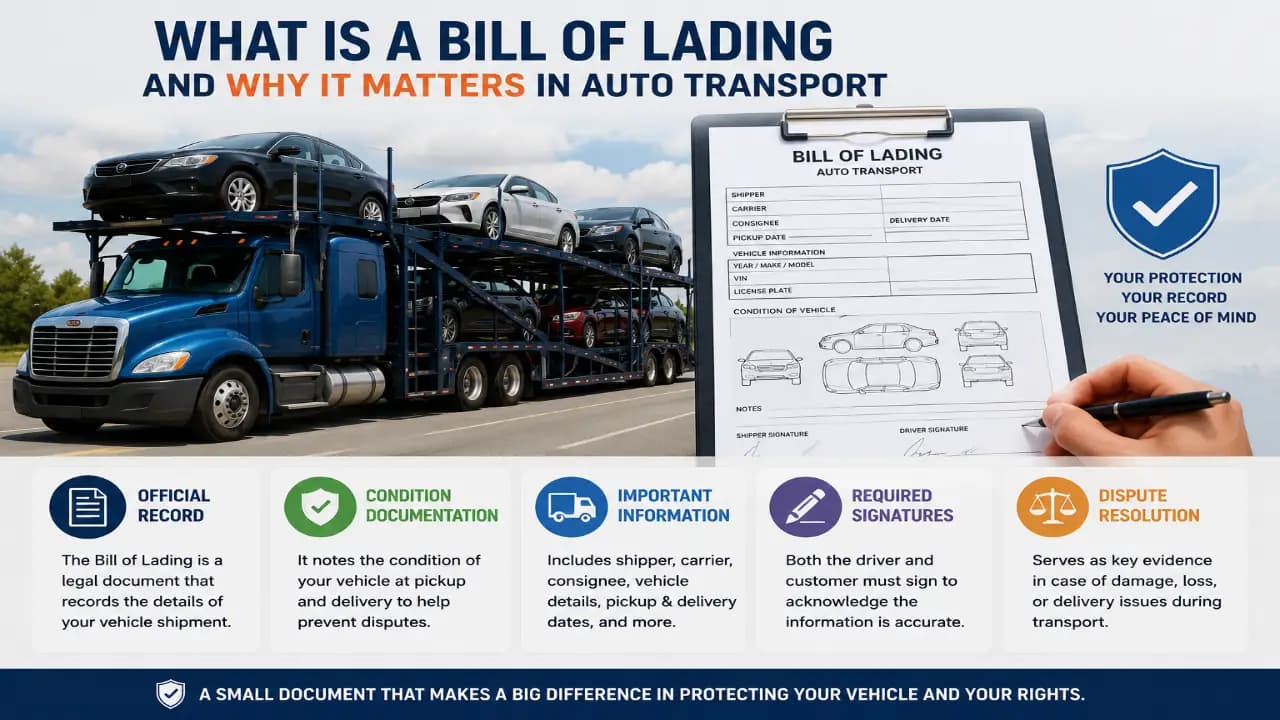
What Is a Bill of Lading and Why It Matters in Auto Transport
The bill of lading is your legal protection in every car shipment. Learn what it documents, how to read it, and why inspection notes make or break a damage claim.
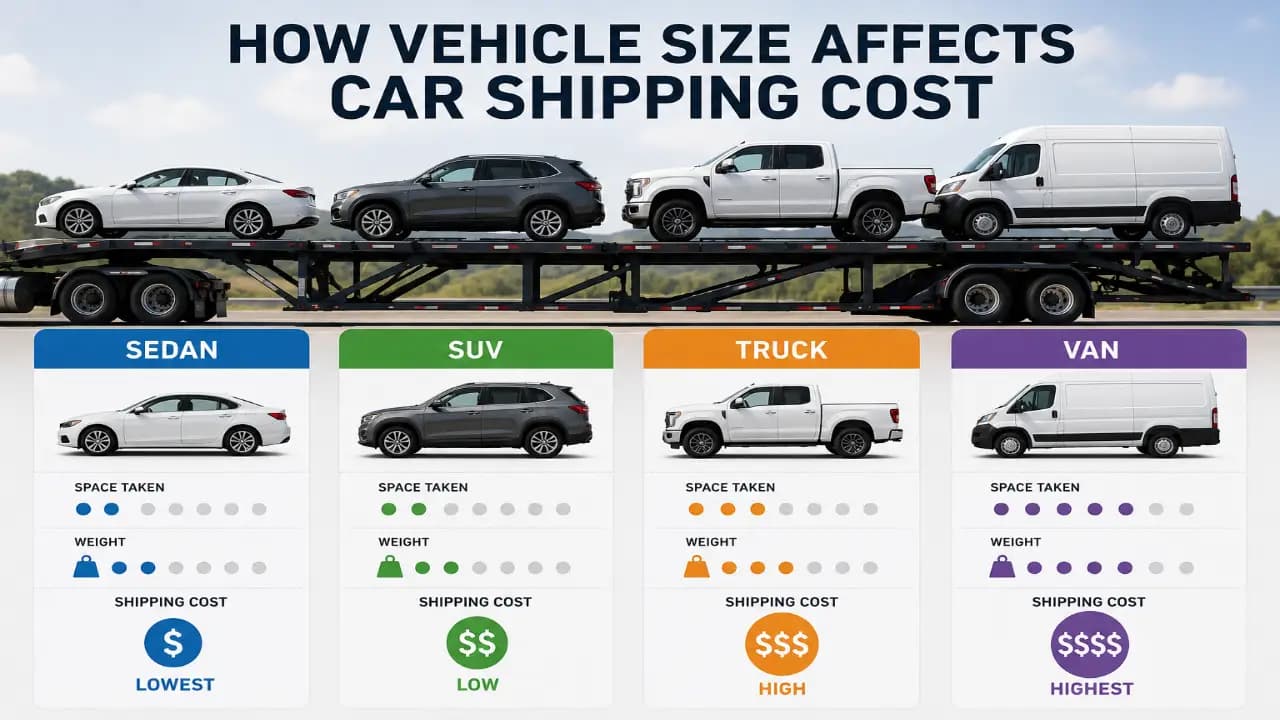
How Vehicle Size Affects Car Shipping Cost: Sedans, SUVs, Trucks & Vans
Bigger cars cost more to ship — but why? Learn how weight and dimensions affect carrier pricing for sedans, SUVs, trucks, and vans.
Ready to Ship Your Vehicle?
Get an instant quote for professional auto transport services.
Get Free Quote