How Vehicle Size Affects Car Shipping Cost: Sedans, SUVs, Trucks & Vans
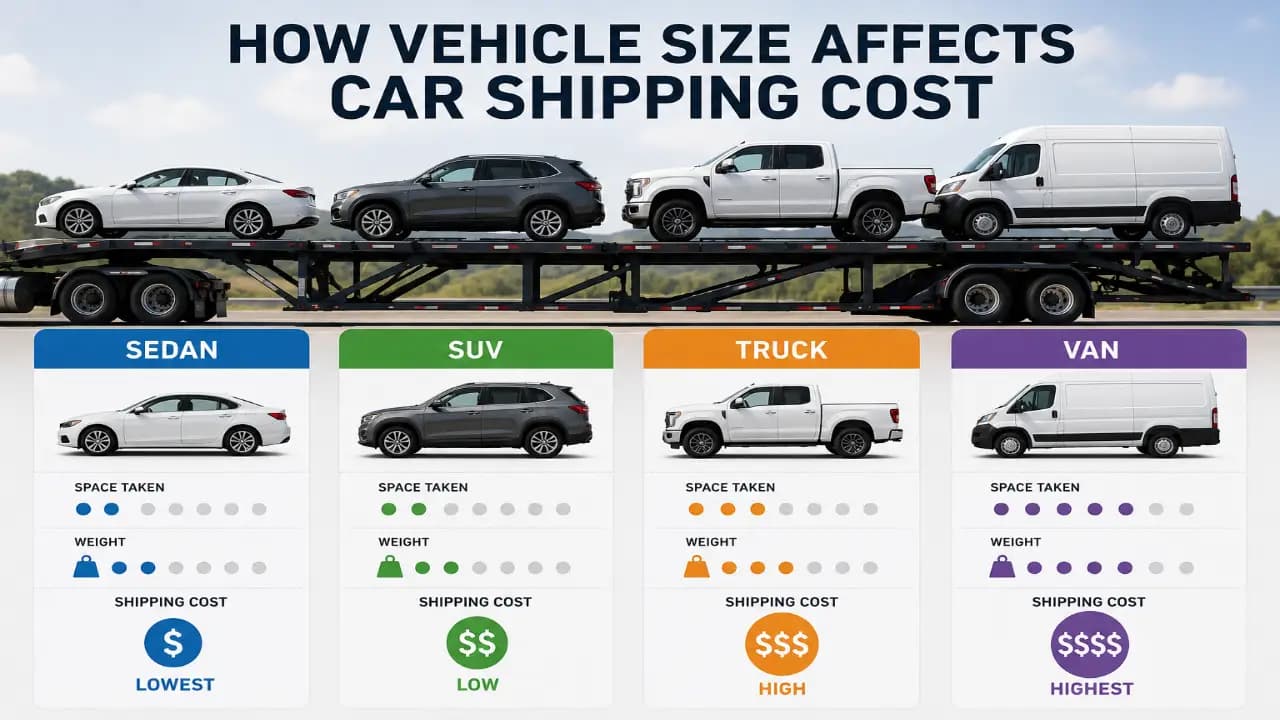
Table of Contents
- Why Your Car's Size Changes the Price Immediately
- The Carrier Math Most People Never See
- Sedan Pricing: The Cheapest Slot on the Truck
- SUV and Crossover Pricing: Where Costs Start Climbing
- Full-Size Trucks: Why That Lifted F-250 Costs More
- Vans and Oversized Rigs: The Premium Tier
- Size-by-Size Cost Comparison Table
- How to Lower Your Bill Without Switching Cars
- FAQs
- Get Your Size-Adjusted Quote Today
Why Your Car's Size Changes the Price Immediately
Size is one of the first things a carrier looks at. It shapes the whole quote. Your car shipping cost goes up as your car gets longer, taller, and heavier.
This surprises a lot of people. They assume the price is all about distance. Distance matters a lot. Size is the second biggest factor. On short routes, it can matter even more.
Every inch and every pound affects what a carrier can charge. It shapes how many cars fit on a load. It also changes how much fuel the truck burns.
Here's the simple version. Carriers make money by loading as many cars per trip as possible. A small sedan takes up one slot. A long-bed truck with a lifted suspension can eat two slots. The carrier has to charge you for both.
The Carrier Math Most People Never See
A standard open carrier holds 8–10 cars. That's it. Every slot is money. Carriers price each spot by how much space the car takes up. Not just the weight.
They use three measurements to price your spot:
- Length — The single biggest factor. A car over 18 feet starts cutting into the slot behind it.
- Height — Taller cars go on the bottom deck. That limits what loads above them. Tall SUVs and vans with roof racks get flagged fast.
- Weight — Heavier cars burn more fuel per mile. Carriers track this closely on long hauls like LA to Chicago.
Dispatch teams run this math daily. On busy lanes like I-10 or I-95, they fill loads fast. But an oversized rig? That can sit 2–3 extra days waiting for the right load configuration.
That wait costs you money — either in expedite fees or in delayed pickup. Simple, but most people skip it.
Quick Tip: Tell your broker your exact specs. That means length, height, any lift kit, and any roof rack. Wrong info causes the driver to reject your car at pickup. That restart costs $100–$200 and adds days to your timeline.
Sedan Pricing: The Cheapest Slot on the Truck
Sedans are the easiest cars to ship. Full stop. Think Honda Civic, Toyota Camry, or Ford Fusion. These are the ideal load for any carrier.
Why? They're short, low, and light. They fit on the upper deck of an open carrier. That frees up the lower deck for bigger rigs. Carriers love them.
Chicago to Dallas? Expect $750–$950 for a sedan on open transport.
Compact cars and coupes sit at the low end. They measure under 15 feet long and weigh under 3,000 lbs. Every carrier wants them.
Is that price fair? Yes. You get fast dispatch, easy loading, and no extra fees. Most sedans clear pickup within 1–3 business days on popular routes.
Sedan pricing only jumps for luxury models heading into enclosed transport. That adds $300–$600 to any quote regardless of size.
SUV and Crossover Pricing: Where Costs Start Climbing
This is where most families get surprised. An SUV looks like a big car. But to a carrier, it's a different animal entirely.
A Honda Pilot or Ford Explorer runs about 16–17 feet long. It also sits higher than a sedan. That height puts it on the lower deck. The lower deck fits fewer cars. A load full of tall SUVs earns the carrier less per trip.
Expect $100–$200 more than a sedan. No upgrades needed to hit that gap.
Full-size SUVs cost more to ship. A Suburban or Expedition runs nearly 19 feet. That's getting into truck territory. At that size, the upper deck is gone.
Here's what can go wrong. You book based on a generic "SUV" category. But your Expedition has a roof rack and it's jacked up two inches. The driver shows up, measures the height, and it doesn't fit the load. Now you're rebooked — and paying for it.
Tell your broker the exact height with any rack or lift included. Every time. It prevents that scenario.
Full-Size Trucks: Why That Lifted F-250 Costs More
Trucks are the tricky ones. A base F-150 or Ram 1500 ships close to SUV pricing. Add a crew cab and a long bed, and the math changes fast.
A crew cab long-bed F-150 clears 21 feet. A lifted F-250 with a 6-inch lift hits 7–8 feet tall. That's a problem. That's a problem on every level of the carrier.
Too long? You block the slot behind you. Too tall? You don't clear the upper deck ramps. Either way, the cost falls on you.
Houston to Atlanta with a lifted long-bed? Budget $200–$400 more than a stock sedan.
Does that feel like a lot? It is. Think about the carrier's side. That truck might cut their load from 9 cars down to 7. They fix that math by charging more.
One more thing: work trucks often come loaded. Toolboxes, bed covers, custom bumpers — all of it adds height and weight. Declare every add-on at booking. Don't hide the bed cover.
Vans and Oversized Rigs: The Premium Tier
Vans top the size chart. A Ford Transit High Roof or Sprinter can hit 9–10 feet tall. That's too tall for an open carrier entirely.
Not an exaggeration. Every open carrier has a height limit on the top deck. Most max out at 7 feet up top. A high-roof Transit won't fit.
Those rigs need a flatbed or specialty enclosed carrier. Both cost extra. Flatbed rates run $1,200–$2,000 by route. Enclosed specialty transport is even higher.
Shipping a high-roof van or extended Sprinter? Budget at least $300–$700 above a standard open quote.
Most brokers won't say this upfront. Not every carrier in their network runs flatbeds. Dispatch on vans and oversized rigs takes longer. Sometimes 3–5 extra days just to find the right truck. Plan for it. Book early.
Minivans are different. A Honda Odyssey or Chrysler Pacifica fits any standard open carrier. The price gap from a sedan is small. Usually $75–$125. In carrier terms, a minivan is closer to a large sedan.
Size-by-Size Cost Comparison Table
Here's a straight look at how size moves the price on a mid-range route. About 1,200 miles — think Chicago to Dallas or Boston to Atlanta. Open transport. Standard booking. 3–5 days dispatch.
| Car Type | Example Models | Avg Length | Avg Weight | Est. Shipping Cost | Carrier Deck |
|---|---|---|---|---|---|
| Compact Sedan / Coupe | Civic, Corolla, Mazda3 | 14–15 ft | 2,700–3,100 lbs | $700–$900 | Upper or lower |
| Mid-Size Sedan | Camry, Accord, Fusion | 15–16 ft | 3,000–3,500 lbs | $750–$950 | Upper or lower |
| Mid-Size SUV / Crossover | Pilot, Explorer, Highlander | 16–17 ft | 4,000–4,800 lbs | $850–$1,100 | Lower deck (height) |
| Full-Size SUV | Suburban, Expedition, Tahoe | 17–19 ft | 5,200–6,000 lbs | $950–$1,250 | Lower deck only |
| Standard Pickup (crew cab) | F-150, Ram 1500, Silverado | 18–20 ft | 4,500–5,500 lbs | $900–$1,150 | Lower deck |
| Heavy-Duty Pickup (lifted) | F-250, Ram 2500, Silverado HD | 20–22 ft | 6,000–7,500 lbs | $1,100–$1,500 | Lower deck / flatbed |
| Minivan | Odyssey, Pacifica, Sienna | 16–17 ft | 4,300–4,800 lbs | $800–$1,050 | Lower deck |
| Full-Size Cargo Van (high roof) | Transit High Roof, Sprinter | 19–22 ft | 5,500–7,000 lbs | $1,200–$2,000+ | Flatbed required |
These numbers move with season, route demand, and dispatch speed. January on I-80 looks different from July. Same lane, different price.
How to Lower Your Bill Without Switching Cars
You can't change your car. But you can change how you ship it. A few moves cut real money off the bill.
Book early. Last-minute bookings cost $150–$300 more. Bigger rigs get even tighter dispatch windows. Shipping an F-350 or Transit? Book 2–3 weeks out. Not one week. Not the day before.
Know your car's actual dimensions. Don't guess. Look up your year, make, and model online. Add any lift height on top of the stock spec. Write it down before you call a broker. This five-minute step prevents the most common and costly pickup problem in auto transport.
Remove the roof rack. A removable rack drops your height by 4–6 inches. That can put you back on the upper deck. Saves $75–$150.
Be flexible on dates. Carriers build loads by geography. Accept a 2–3 day pickup window instead of an exact date. You'll match with a load that fits your size. That cuts cost and speeds dispatch.
The single biggest money saver: accurate specs at booking. Wrong info means rejected pickups, rebooking fees, and lost days.
Choose open transport unless your car truly needs enclosed. For a daily driver, open is fine. Enclosed costs $300–$600 more. Most trucks don't need it.
The biggest mistake? Booking enclosed just to be safe. Don't. Open ships millions of cars every year. Most arrive with zero issues.
FAQs
Does a heavier car always cost more to ship?
Weight is a factor, but length and height matter just as much. A heavy compact car often ships cheaper than a lighter but very long one. Carriers think in slots, not just pounds. A 4,500-lb sedan on the upper deck costs less than a 4,000-lb lifted pickup. The pickup blocks the slot behind it. Weight matters most on long routes. Fuel costs add up fast.
How much more does it cost to ship an SUV vs a sedan?
Expect $100–$250 more for a mid-size SUV. That's on routes of 1,000–1,500 miles. Full-size SUVs like a Suburban or Expedition can push that difference to $300–$400. That gap widens in winter. High-demand lanes like I-10 and I-95 push it even further.
Will a lift kit on my truck raise my shipping cost?
Yes — and more than most people expect. A 4-inch lift can push some trucks off the upper deck. Entirely. A 6-inch lift on a long-bed crew cab? Standard open carriers won't work. You'll need a flatbed. Always tell your broker the lifted height, not the stock height. If you don't, the driver may reject your car at pickup. That means a rebooking fee and days of delay.
Can I ship a high-roof cargo van on a standard open carrier?
Usually not. Most high-roof Transits and extended Sprinters clear 9–10 feet tall. Standard open carriers max out at about 7 feet on the upper deck. A high-roof van needs a flatbed or a specialized enclosed carrier. Budget $1,200–$2,000. Expect longer dispatch too — sometimes 3–5 extra days. Most networks have limited flatbed capacity.
Does a truck with a long bed cost more than a short bed?
Yes. Length is the issue here. A crew cab short-bed F-150 comes in around 19 feet. A crew cab long-bed F-150 hits nearly 22 feet. That 3-foot difference cuts into the slot behind it on the carrier. You pay for the partial second slot. Or the carrier skips your booking until a better load comes together. Long-bed crew cabs run $75–$150 more than the same truck in short-bed.
What happens if I give the wrong dimensions at booking?
The driver shows up, measures your car, and it doesn't match the booking. At that point, they reject it or charge an oversize fee. A rejection resets everything. New dispatch, new wait, and a rebooking fee of $100–$200. It's one of the most avoidable problems in auto transport. Measure your car accurately, including any rack, lift, or aftermarket bumper, before you book.
Does shipping a minivan cost the same as a full-size SUV?
Close, but not quite. An Odyssey or Pacifica runs $75–$125 more than a mid-size sedan on most routes. That puts them below most full-size SUVs in price. Minivans are lower to the ground than many SUVs, which helps with deck placement. On routes like Florida to the Northeast, minivan pricing stays competitive. Carriers see them all the time and load them easily.
Is open transport safe for a large truck or SUV?
Yes. For most trucks and SUVs, open transport is perfectly safe. Millions of full-size pickups and SUVs ship open every year without damage. Enclosed makes sense for a brand-new luxury SUV. Or fresh paint you can't risk chipping. For a daily-driver F-150 or Tahoe? Open is the right call. You pay less, dispatch faster, and the outcome is the same.
Get Your Size-Adjusted Quote Today
Your car's size shapes your quote more than most people realize. The good news: once you know the math, you can plan around it. Run the numbers yourself with our car shipping cost calculator.
Ready to book? Get a free, size-accurate quote from Furious Auto Shipping today. We get your specs right the first time. No surprises at pickup.
About the Author
Sarah Williams
Sarah is a logistics expert with over 20 years of experience in the auto transport industry.
Related Articles

How Much Does It Cost to Ship a Car in 2026? Complete Pricing Guide
Get real 2026 car shipping costs broken down by distance, vehicle type, and service level. Our 20-year industry expert reveals insider pricing tips most companies won't share.

Open vs Enclosed Auto Transport: Which Should You Choose?
Deciding between open and enclosed transport? Learn the pros and cons of each option to make the best choice for your vehicle.
Ready to Ship Your Vehicle?
Get an instant quote for professional auto transport services.
Get Free Quote