What Is a Bill of Lading and Why It Matters in Auto Transport
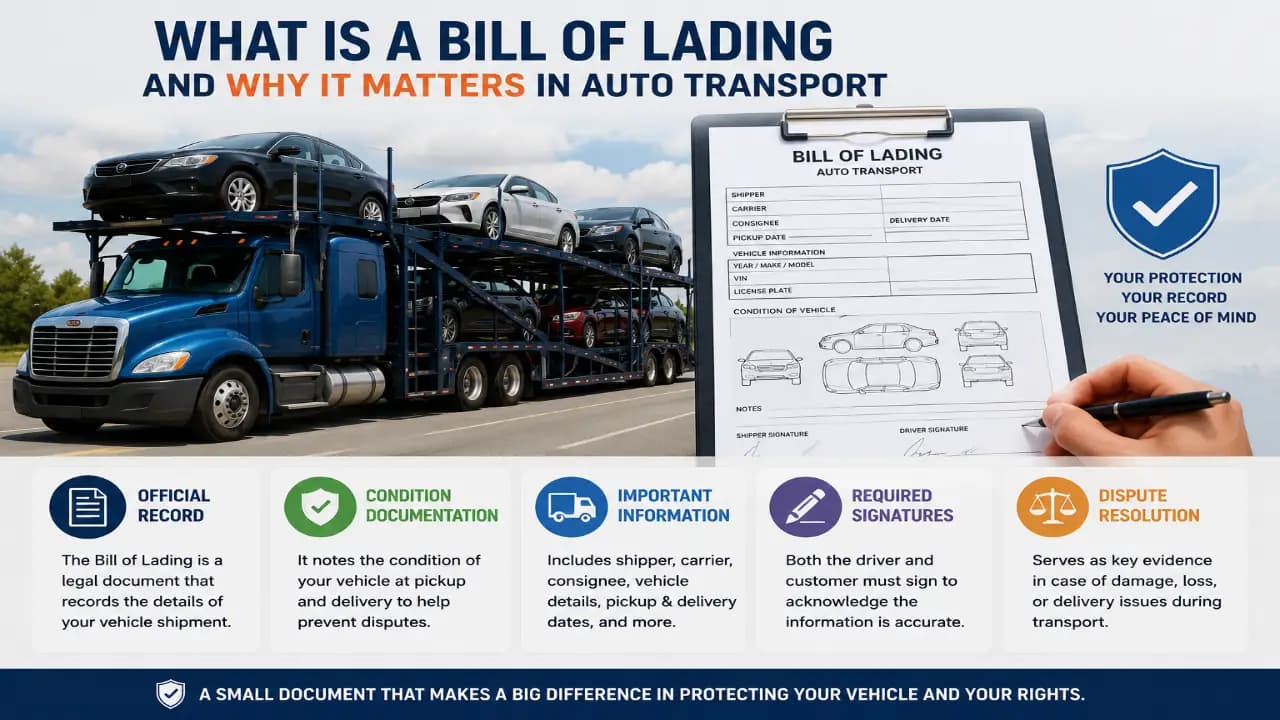
Table of Contents
- What a Bill of Lading Actually Is
- What the BOL Documents — Field by Field
- Why Pickup Inspection Notes Can Win or Lose a Damage Claim
- How to Read Your BOL Without Getting Confused
- What to Do With Your BOL at Delivery
- Mistakes That Kill Damage Claims Before They Start
- BOL vs. No BOL: What You Risk Without a Paper Trail
- FAQs
- Get Your Quote Today
What a Bill of Lading Actually Is
Most people hear "bill of lading" and think it's just paperwork. It's not.
The BOL is your most important document. It protects you in every car shipping transaction.
It does three things at once. It serves as your shipping contract. It records your car's condition at pickup.
It proves delivery when the job is done. That's the whole purpose.
Think of it like a rental car form. You walk the lot with the agent. You note every scratch.
You both sign. That form protects you if something goes wrong. Your BOL does the same thing — but for shipping.
What the BOL Documents — Field by Field
Every BOL covers the same core details. Knowing each field stops you from signing something incomplete.
Here's what you'll find on every standard BOL. Know each field.
- Shipper details — your name, phone, and pickup address
- Receiver details — who accepts the car at drop-off and where
- Carrier information — the trucking company's name, DOT number, and MC number
- Car description — year, make, model, color, and VIN
- Odometer reading — mileage at pickup and again at delivery
- Condition report — pre-existing damage noted on a car diagram
- Personal items declaration — what's in the car and its stated weight
- Signatures — driver and customer at pickup; driver and receiver at delivery
Every field matters. An empty field is a gap in your protection.
The condition report is the one most people ignore. That's a mistake.
The driver notes a scratch at pickup. You see it, you agree, you sign.
They miss a scratch? Note it yourself before signing. That's not optional.
Why Pickup Inspection Notes Can Win or Lose a Damage Claim
Here's how damage claims actually go. The carrier's insurance asks one question first. Was the damage on the BOL at pickup?
If yes — they know the damage happened before transit. Claim denied.
If no — they check the delivery BOL. Was it noted there?
If yes, and not at pickup, the carrier is on the hook. That's your claim.
Simple, right? Most people don't walk their car with the driver. They hand over the keys and step back.
Then at delivery — chip in the door. No note at pickup. No claim.
You must walk the car with the driver at pickup. Every time. No exceptions.
Does it feel awkward? A little. But a good driver expects it.
Any driver who rushes you — that's a red flag. Slow down. Check the hood, roof, door edges, mirrors, and bumpers.
Take photos before you hand over the keys. Every time.
I've seen claims fall apart because a customer skipped noting an old dent. The carrier couldn't prove it was pre-existing. That fight takes months.
Save yourself the headache. Note it at pickup.
Want to know if your carrier's coverage is solid? Good question. Read how auto transport safety and insurance actually works before your booking date.
How to Read Your BOL Without Getting Confused
BOLs look intimidating. They're not. Break it into three zones.
Zone 1 — Top section. This is admin. Your name, driver's name, addresses, the date.
Read it. Confirm it matches your booking.
Zone 2 — Middle section. This is the condition report. It's a diagram of a car — top view and side view.
The driver marks damage with codes. "SC" means scratch. "DN" means dent.
"CH" means chip. "CR" means crack. Simple system.
Don't trust a blank diagram. That's not "no damage." That means nobody looked.
Zone 3 — Bottom section. Signatures and dates. Both parties sign at pickup and delivery.
The delivery box is where you write new damage. That's the note that starts a claim.
Never sign the delivery section until you've walked the car again. Check in daylight. Match it to the pickup BOL.
Signing at delivery closes the record. Once you sign with no notes, the carrier's job is done. Whatever you find after — that's yours to carry.
Pro Tip: Take a timestamped photo of the BOL at pickup and delivery. Email it to yourself right away. That timestamp is key evidence if a dispute drags past 30 days.
What to Do With Your BOL at Delivery
The driver shows up. You're excited. Don't rush.
Step 1 — Get the car off the truck first. Check it on flat ground. Not on the ramp.
Step 2 — Check it in daylight. Not a streetlight. Not inside a garage.
Exterior damage needs real light.
Step 3 — Compare it to your pickup photos. Go panel by panel. Hood, roof, doors, rear bumper, mirrors.
Step 4 — Write any new damage directly on the delivery BOL. Be specific. "Scratch, driver door, 3 inches, near handle." Not just "scratch."
Step 5 — Both you and the driver sign. The driver may disagree. That's fine.
Sign with your notes anyway. Your written record stands.
Step 6 — Get a copy. A photo of the signed form counts. The driver should give you a physical copy too.
One more thing. If the driver is rushing you — say it out loud. "I need five minutes to check the car."
Most carriers want a clean delivery. A driver pushing you to sign fast? Note that on the form too.
Mistakes That Kill Damage Claims Before They Start
I've seen dozens of customers lose valid claims. Not because the carrier was right. The paperwork was wrong.
Mistake 1 — Signing a blank condition report. The driver says "it's fine, I'll fill it in after." Don't accept that. Fill it in together, right now, before you hand over the keys.
Mistake 2 — Not keeping your copy. The BOL is useless if you can't produce it. Get a photo.
Email it. Store it somewhere you'll find it in 30 days.
Mistake 3 — Inspecting in low light. A dent in a dark garage looks like a shadow.
Check in daylight. Every time.
Mistake 4 — Signing delivery before checking. Once you sign with no notes, the claim window closes. Even if you find damage an hour later — you're starting from behind.
Mistake 5 — Vague damage descriptions. "There's a scratch" won't move an insurance adjuster. "Scratch, passenger fender, six inches, near wheel arch" will.
Be specific. Be fast. That's the whole game.
Before your pickup date, read how to prepare your car for transport. Prep reduces disputes. A clean car with documented pre-existing damage gives you a solid baseline.
BOL vs. No BOL: What You Risk Without a Paper Trail
| Scenario | With a Complete BOL | Without a Complete BOL |
|---|---|---|
| Pre-existing scratch found at delivery | Noted at pickup — no claim needed | No proof it was pre-existing — dispute starts |
| New dent found at delivery | Not on pickup BOL — carrier is liable | No baseline — carrier denies responsibility |
| Odometer discrepancy | Pickup mileage on record — easy to prove | No record — your word against the driver's |
| Carrier disputes delivery date | Signed, dated delivery record on file | No proof of when or where delivery occurred |
| Insurance claim filed | BOL supports claim — adjuster has evidence | Claim likely denied — no BOL on file |
| Personal items dispute | Items declared and signed for at pickup | No record — no recovery |
The pattern is clear. Every risk on the right comes from a missing BOL.
None of this is hard to prevent. Five minutes at pickup. Five minutes at delivery.
FAQs
What is a bill of lading in car shipping?
A BOL is your legal record. It captures your car's condition at pickup and confirms delivery.
Both you and the driver sign at pickup and again at drop-off. No BOL, no legal record. No record, no damage claim.
Do I have to sign a bill of lading before pickup?
Yes. The driver presents the BOL before loading. You both inspect the car, note damage, and sign.
If a driver shows up without a BOL — stop. Don't sign a blank form. Call your broker right away.
What happens if damage shows up after I sign the delivery BOL?
This is tough. Once you sign with no damage noted, the record shows the car arrived clean.
You can still call the carrier. But your case is weak without delivery notes. Check the car before you sign — not after.
Find damage the same day after signing? Call the carrier within 24 hours and photograph everything.
Can I refuse to sign the BOL at delivery?
You can — but it creates problems. Refuse to sign, and delivery isn't complete. Better move: note the damage, sign, then escalate through the carrier's insurance.
How long do I have to file a damage claim after delivery?
Most carriers require written notice within 15 days. Some contracts say 30 days. Check your agreement for the exact window.
File as soon as you find damage. Clear BOL notes and photos move claims fast. Claims with no BOL drag for months.
What does the condition diagram on the BOL mean?
It's a top-view and side-view diagram. The driver marks damage using codes.
SC = scratch, DN = dent, CH = chip, CR = crack. Learn them.
Every pickup mark is pre-existing. The carrier owes you nothing for it.
New damage at delivery? That's on them. Treat the diagram as your baseline.
Should I take photos even if the BOL is filled out?
Always. Photos and the BOL work together. A photo gives visual proof.
Take timestamped photos before the car loads. Email them right away. Thirty days later, that timestamp proves everything.
Is the bill of lading the same as my shipping contract?
They're related but different. Your contract covers the booking terms — price, window, cancellation.
The BOL is the driver's form. It records your car's condition and confirms handoff. Keep both for 90 days.
Protect Your Car From the First Signature to the Last
Your BOL is your best protection. Walk the car at pickup. Never sign at delivery before you check every panel.
Ready to book? Use our car shipping cost calculator for an instant price. Or get a free quote and we'll walk you through every step.
About the Author
Sarah Williams
Sarah is a logistics expert with over 20 years of experience in the auto transport industry.
Related Articles

Is Auto Transport Safe? What Every Car Owner Should Know
Worried about shipping your car? A 20-year industry veteran reveals the real safety record, insurance facts, and insider tips to protect your vehicle during transport.

How to Prepare Your Car for Transport: Ultimate Checklist
Learn exactly how to prepare your car for transport. A 20-year industry expert shares the ultimate checklist to ensure a smooth, damage-free shipping process.
Ready to Ship Your Vehicle?
Get an instant quote for professional auto transport services.
Get Free Quote