Loading...

Car Shipping from New Jersey to Arizona (NJ to AZ) 2026
Escaping New Jersey taxes for Phoenix sunshine? Here's what every NJ-to-AZ shipper needs to know before booking — including the one booking mistake that costs $200.
• No Credit Card Required • $0 Upfront Deposit
Loading quote form...
The New Jersey Tax Exodus Is Real — and It Runs Straight Down I-40
Car shipping from New Jersey to Arizona covers 2,350–2,500 miles and takes 6–9 days on standard dispatch. This is one of the fastest-growing relocation corridors in the country right now. New Jersey has the highest property tax rate in the US. Arizona has none on primary residences and a flat income tax. That gap is moving thousands of families west every year.
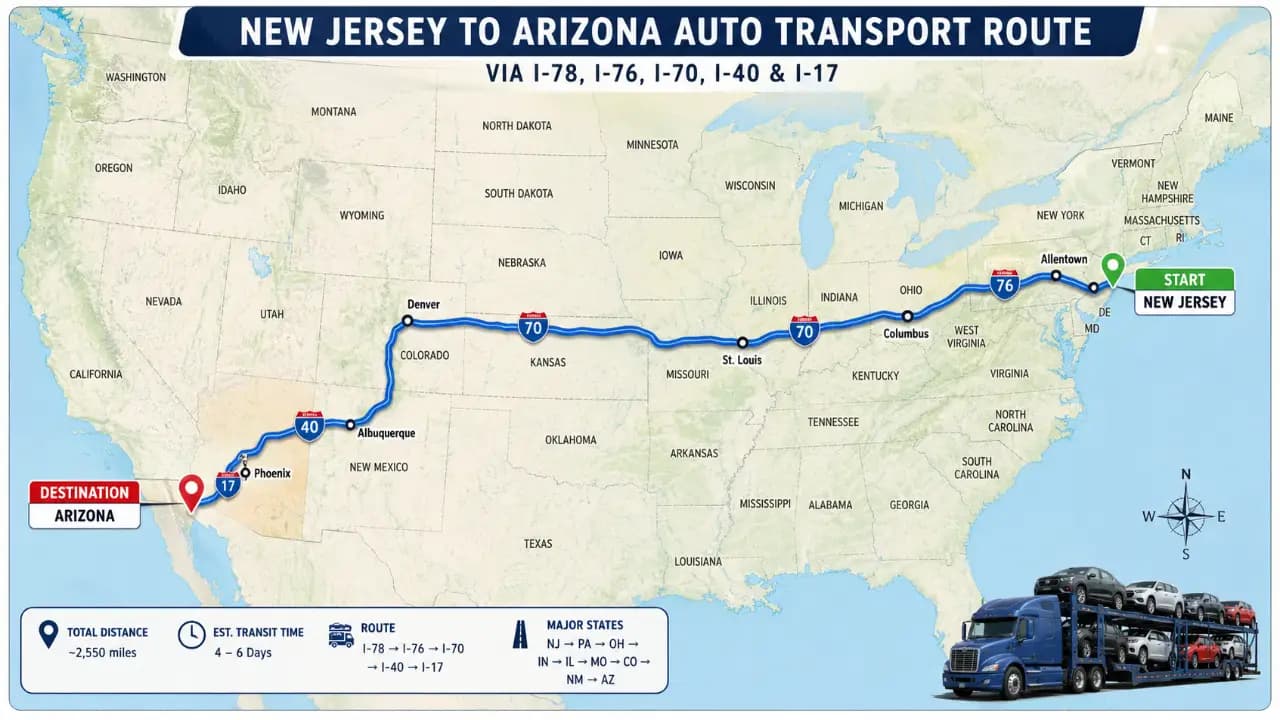
The main highway chain is I-78 West out of northern NJ, connecting to the Pennsylvania Turnpike (I-76), then I-70 West through Ohio and Kansas, picking up I-40 West through Oklahoma and the Texas Panhandle, and finishing on I-17 South into Phoenix or I-10 West into Tucson. That's a lot of terrain. Fuel costs on this run are real, and they affect your rate.
Furious Auto Shipping dispatches on this corridor every week. We know where trucks stage, where they slow, and when to book. Miss the peak window and you pay more. Book now and we lock in your rate before summer demand hits. Most customers wait too long. Don't be one of them.
Corporate / Lifestyle Relocation
The Phoenix metro added over 85,000 jobs in healthcare, finance, and semiconductor manufacturing in 2023–2024. TSMC's fab campus in north Phoenix pulled thousands of tech workers from the Northeast. At the same time, New Jersey's effective total tax burden sits near 13%—one of the highest in the nation. Arizona's is under 9%. That math is driving a sustained westbound relocation wave that peaks every summer when school years end.
Aerial Distance
Miles
(depending on city pairs)
Estimated Transit Time
Days
Common Route
I-78 W, I-76 W, I-70 W, I-40 W, I-17 S
Driver Availability
Moderate — this lane runs 2–3 trucks per week westbound; eastbound return loads are lighter so westbound slots book fast in summer
Daily Dispatches
Average Cost Ranges: New Jersey to Arizona
| Vehicle Type | Open Transport | Enclosed Transport | Why the Difference? |
|---|---|---|---|
| Sedan (e.g., Honda Accord) | $850–$1,150 | $1,350–$1,750 | Standard deck space; most common vehicle on this lane |
| Small SUV (e.g., Toyota RAV4) | $950–$1,250 | $1,500–$1,900 | Slightly taller profile; takes more deck height on the hauler |
| Large SUV (e.g., Chevy Suburban) | $1,100–$1,450 | $1,750–$2,150 | Full deck space; high weight adds fuel cost across 2,400 miles |
| Pickup Truck (e.g., Ford F-150) | $1,050–$1,400 | $1,700–$2,100 | Bed length affects hauler positioning; extended and crew cabs cost more |
| Luxury / Exotic | N/A — Enclosed Recommended | $1,800–$2,500 | Desert UV and I-17 descent heat make enclosed the only safe option above $50K |
Note: Prices shown are market averages. Actual rates vary due to fuel surcharges and seasonal demand. Contact us for a precise quote.
I-40 West Through the Texas Panhandle — the Longest Flat Stretch on This Run
Distance: ~2,350–2,500 miles
New Jersey to Arizona vehicle shipping follows a five-highway chain across 2,350–2,500 miles. Here's how it breaks down. Leg 1 — I-78 West (NJ to PA border): Pickups in northern and central NJ feed onto I-78 West. This stretch is manageable. But the exit ramps in Elizabeth and Springfield are tight for a 10-car hauler. Drivers plan their pickup sequence around this. Leg 2 — I-76 West (Pennsylvania Turnpike): From the PA border through Pittsburgh, the Turnpike is the main artery. The Allegheny Mountain grade near Somerset climbs to 2,900 feet. Loaded carriers slow to 45 mph here. That's not a complaint — it's physics. Leg 3 — I-70 West through Ohio, Indiana, Illinois, Missouri, and Kansas: This is the smooth middle. Flat terrain, good pavement, consistent 65 mph movement. Carriers make up time here. Kansas City is the biggest fuel stop on this run. Leg 4 — I-40 West (Oklahoma City through Albuquerque): The Texas Panhandle on I-40 is wide open and fast. Wind is the enemy here. Crosswinds in the Amarillo corridor hit 40–60 mph in spring. Drivers watch weather hard on this stretch. Leg 5 — I-17 South or I-10 West (Arizona final leg): Phoenix-bound loads drop onto I-17 South from Flagstaff. Tucson runs on I-10 West. The I-17 descent from Flagstaff to Phoenix drops 6,000 feet in 30 miles. Experienced drivers take it slow. Inexperienced ones don't.
I-70 West — Ohio to Kansas: The Smooth Middle Where Drivers Make Up Time
Flat terrain, consistent speed limits, and minimal construction make this the easiest leg on the run. Carriers often make 500 miles per day through this stretch. It's where transit time gets recovered after PA mountain delays.
I-76 West — Allegheny Mountains Near Somerset, PA: The Grade That Slows Every Loaded Hauler
The Allegheny summit near Somerset forces loaded carriers down to 45 mph. Winter adds ice risk. This is the most common cause of 1-day transit delays on this corridor. Book a flexible pickup window if your ship date is November through March.
I-17 South — Flagstaff to Phoenix: The 6,000-Foot Descent That Separates Good Drivers From Great Ones
The Black Canyon highway drops steeply from Flagstaff into the Valley of the Sun. Brake fade on loaded haulers is a real concern. Experienced carriers take this section in the early morning hours to avoid midday heat and traffic.
The I-40 Bait-and-Switch: How NJ-to-AZ Shippers Get Trapped at Pickup
This corridor has a well-known scam pattern. A broker quotes $750 for your sedan. It sounds great. You pay a deposit. Then the driver shows up and says the price went up — fuel costs, oversize fees, whatever excuse works. You're standing in your driveway with a moving truck already scheduled. You pay it. Warning: If a quote for a sedan on this run is under $850, it is a lowball. The market rate is $850–$1,150. Anything under that is bait. Here's what to do. Ask for the carrier's MC number before you pay anything. Go to FMCSA.dot.gov and verify it takes 30 seconds. Make sure they carry cargo insurance. Get the driver's name and truck number 24 hours before pickup. Furious Auto Shipping gives you all of this upfront — no surprises at the curb.
Red Flag
Warning: If a quote looks too good to be true on this corridor, verify the broker's MC number and bond status at FMCSA.dot.gov before paying anything.
Elizabeth NJ Curb Pickups vs Scottsdale HOA Gates — Two Very Different Last Miles
New Jersey Pickups: Most of New Jersey is door-to-door friendly for auto transport. Newark, Jersey City, and Hoboken are the exceptions. Narrow one-way streets and no-commercial-vehicle zones in downtown Hoboken mean your driver may stage at the Home Depot on Route 440 in Jersey City — about 1.5 miles from most Hoboken addresses. Newark pickups near the Ironbound District work best from the Walmart on Wilson Avenue staging lot. Northern NJ suburbs — Bergen County, Morris County, Essex County — are fully door-to-door. New Jersey uses E-ZPass on all major toll roads including the Turnpike and Garden State Parkway. Your carrier handles tolls — they're already priced in.
Arizona Deliveries: Phoenix metro deliveries are mostly door-to-door. The exception is gated HOA communities, which are everywhere in Scottsdale, Chandler, Gilbert, and Peoria. Many HOA gates require a resident key fob or code — your driver won't have it. Plan to meet the driver at the community entrance or give the gate code in advance. Old Town Scottsdale has narrow alleys near the arts district that won't fit a 10-car hauler. Drivers stage at the Home Depot on N Scottsdale Road near Thomas Road — about 0.8 miles from most Old Town addresses. Tucson deliveries are fully door-to-door in most zip codes. Arizona has no statewide toll roads — no toll pass needed.
The Seamless Auto Transport Process
From New Jersey to Arizona
We have refined our process to be as simple and transparent as possible. Here's a step-by-step overview of how we handle your shipment:
Get Your Free Quote
Start by filling out our easy online quote form. Provide basic information about your vehicle, the pickup location in New Jersey, and the delivery location in Arizona. Our team will quickly provide a competitive and transparent quote with no hidden fees.
Schedule Your Shipment
Once you accept the quote, a dedicated transport coordinator will work with you to schedule the pickup. We strive to provide flexible pickup windows that align with your schedule.
Vehicle Preparation
Before pickup, we recommend a few simple steps to prepare your vehicle. We provide a detailed checklist to ensure a smooth transition, including checking fluid levels, removing personal items, and leaving a quarter tank of gas.
The Pickup
A professional, fully insured driver will arrive at your designated location in New Jersey. Together, you will conduct a thorough inspection of the vehicle and document its current condition on a Bill of Lading. This document is your record and protection.
Secure Transit
Your vehicle is loaded onto the carrier and begins its journey to Arizona. We provide real-time tracking and updates, allowing you to monitor your vehicle's progress and stay informed throughout the transport.
The Delivery
The driver will contact you as they approach the delivery location in Arizona. At the time of delivery, you will perform a final inspection of your vehicle and sign the Bill of Lading to confirm its condition upon arrival.
Ready to Ship Your Vehicle from New Jersey to Arizona?
Get your free quote today and experience professional auto transport service with competitive rates and excellent customer support.
What NJ-to-AZ Car Shipping Actually Costs in 2026 — and What Moves the Price
A standard sedan on this run costs $850–$1,150 for open transport. That's the honest market range for 2026. Most people expect less. Here's why that number is fair.
This is a 2,350–2,500 mile haul. Fuel alone runs $400–$500 per trip for a carrier. The driver earns a per-mile rate. Tolls on the Pennsylvania Turnpike add cost. That all lands in your quote.
Here's what moves your price on this specific corridor:
Vehicle size: A Chevy Suburban runs $200–$300 more than a Honda Accord. It takes up more deck space and weighs more.
Pickup month: A June or July booking adds $150–$250 above the base rate. A January booking saves you that same amount.
Booking lead time: Book 7–10 days ahead in normal months. In June or July, book 2–3 weeks ahead or you pay a premium for last-minute carrier dispatch.
Open vs enclosed: Enclosed adds $450–$750 to any vehicle class on this run.
Inoperable vehicle: Non-running cars add a flat winch fee of $150–$200.
Get your exact number now: Vehicle Shipping Quotes
Estimated Transit Times: New Jersey to Arizona
| Origin City | Destination City | Approx. Miles | Est. Transit Time |
|---|---|---|---|
| Newark, NJ | Phoenix, AZ | 2,370 miles | 6–8 Days |
| Jersey City, NJ | Scottsdale, AZ | 2,390 miles | 6–8 Days |
| Trenton, NJ | Tucson, AZ | 2,310 miles | 6–8 Days |
| Camden, NJ | Mesa, AZ | 2,290 miles | 6–8 Days |
| Atlantic City, NJ | Chandler, AZ | 2,340 miles | 6–8 Days |
| Hackensack, NJ | Tempe, AZ | 2,410 miles | 7–9 Days |
| Paterson, NJ | Gilbert, AZ | 2,400 miles | 7–9 Days |
| Elizabeth, NJ | Peoria, AZ | 2,385 miles | 7–9 Days |
| Edison, NJ | Glendale, AZ | 2,360 miles | 6–8 Days |
| Morristown, NJ | Flagstaff, AZ | 2,430 miles | 7–9 Days |
Note: Estimated transit times for standard dispatch. Severe weather or traffic conditions may impact actual delivery dates.
Seasonal Pricing Trends
Best Time to Ship (Cheapest)
January — post-holiday lull, low corporate relocation activity, carrier supply exceeds demand on this lane
Peak Season (Most Expensive)
July — peak summer relocation season, school-year transitions, maximum corporate transfer activity, carrier slots book 2–3 weeks out
This is a corporate and lifestyle relocation corridor — demand tracks the school calendar and corporate fiscal year, peaking June through August when families move before the new school year.
Jan
Feb
Mar
Apr
May
Jun
Jul
Aug
Sep
Oct
Nov
Dec
Desert Heat on Arrival, Mountain Ice in Transit — Here's How to Protect Your Car
When shipping a car from New Jersey to Arizona, your car moves from a humid mid-Atlantic climate through the Appalachians, the plains, and the high desert before dropping into the Sonoran Desert. That's five distinct climate zones in one trip.
Weather Risk Factors:
- New Jersey origin risk: Road salt residue on the undercarriage from Northeast winters. Ask your driver to photograph the undercarriage at pickup. Salt corrosion is not a shipping damage claim — it's pre-existing.
- Transit risk — Texas Panhandle windstorms: Amarillo corridor crosswinds hit 40–60 mph in March and April. Open transport cars collect dust and light road debris on this stretch. Not damage — just dirty. Plan a wash on arrival.
- Transit risk — I-17 summer heat: Dashboard interiors hit 150°F in a parked car in Arizona summer. If your car has leather seats or a wood-trim dash, enclosed transport cuts UV and heat exposure during delivery staging.
Our Recommendation:
Open transport is the right call for 85% of cars on this route. It costs $850–$1,150 for a sedan and gets the job done safely. Enclosed makes sense if your car is worth $50,000 or more, has a leather interior you care about, or is a classic or exotic. Enclosed runs $1,400–$1,900 on this corridor.
100% Insured & Protected
Every carrier in our network maintains a minimum of $100,000 in cargo insurance. We verify safety ratings and insurance certificates before every dispatch.
Fully Licensed
DOT Certified
A+ Rated
New Jersey Sends More Residents to Arizona Per Capita Than Any Other Northeast State
Arizona's Department of Transportation reports that New Jersey consistently ranks as a top-3 origin state for new Arizona vehicle registrations. The migration accelerated sharply after 2020. Maricopa County — home to Phoenix, Scottsdale, and Chandler — processed more out-of-state NJ title transfers in 2022 and 2023 than any other county in the Southwest. The financial math is simple: a New Jersey family saving $8,000–$12,000 per year in combined taxes after moving to Arizona recoups the cost of shipping their car in the first month.
Preparing Your Vehicle for Transport
Open vs. Enclosed Transport
Open Transport (Most Popular)
- • More affordable option
- • Faster pickup times
- • Perfect for daily drivers
- • Exposed to weather elements
Enclosed Transport (Premium)
- • Complete weather protection
- • Ideal for luxury & classic cars
- • Enhanced security
- • Premium white-glove service
Vehicle Preparation Checklist
Clean Your Vehicle
Makes inspection easier and protects the paint
Remove Personal Items
Not covered by carrier insurance
Check Fluid Levels
Ensure no leaks and proper levels
Document Condition
Take photos of all sides before pickup
Leave ¼ Tank of Gas
Reduces weight while ensuring drivability
Disable Alarms
Prevents issues during transport
Why Westbound NJ-to-AZ Loads Stage in Albuquerque — Not Flagstaff
Here's something most shippers never hear. Carriers running the NJ-to-AZ corridor almost never stage overnight in Flagstaff. Flagstaff sits at 7,000 feet. In winter, overnight temps drop below 20°F. A loaded hauler sitting in those temps overnight risks brake line issues and fuel gelling on diesel rigs. Experienced drivers stage in Albuquerque instead — lower elevation, better truck stop infrastructure, and a 4-hour morning push into Phoenix.
This matters to you because it affects your delivery window. Cars delivered to Phoenix typically arrive in the early morning — before 10am. That's not laziness. That's smart driving. The I-17 descent is cooler and less congested before noon. Furious Auto Shipping dispatchers know this pattern and set your delivery window accordingly.
Frequently Asked Questions: Shipping to Arizona
Common questions about New Jersey to Arizona Car Shipping
Standard dispatch takes 6–9 days for most NJ-to-AZ routes. Newark to Phoenix is about 2,370 miles — carriers average 400–500 miles per day on this corridor. The Allegheny Mountain grade in Pennsylvania and the I-17 descent into Phoenix are the two slowest stretches. Expedited shipping cuts transit to 5–7 days but costs $200–$400 more. If your move date is fixed, book expedited. If you have flexibility, standard dispatch saves money. Winter weather on the Allegheny grade can add 1 day. Build that buffer into your timeline.
A sedan runs $850–$1,150 for open transport. A mid-size SUV runs $950–$1,250. Large SUVs and pickup trucks land between $1,100 and $1,450. Enclosed transport adds $450–$750 to any vehicle class. The biggest price variable on this route is time of year. A June booking costs $150–$250 more than a January booking for the same car. Book 7–10 days ahead in slow months. In June and July, book 2–3 weeks ahead or you risk paying a last-minute premium.
No — not for most cars. Open transport is safe for 85% of vehicles on this corridor. The route does cross desert terrain and the I-17 descent brings some heat exposure during staging, but these are manageable risks for standard vehicles. Choose enclosed if your car is worth $50,000 or more, if it has a convertible soft top, or if it's a classic or exotic. The I-40 Texas Panhandle stretch can be dusty and windy in spring — your car will need a wash on arrival either way. Enclosed costs $1,350–$1,750 for a sedan on this route.
January and February are the cheapest months on this lane. Demand drops sharply after the holiday season. Corporate relocation slows. Carrier supply exceeds demand westbound. You save $150–$200 versus a June or July booking for the same car. The worst time to book is June through August — that's peak summer relocation season and prices jump 20–28% above the annual average. If your move date is flexible at all, push it to January or February. That savings pays for a month of Arizona groceries.
Yes, you can pack up to 100 pounds in the trunk or cargo area. Items must stay below the window line so the driver can see. Personal items are not covered by the carrier's cargo insurance. Pack at your own risk.
Yes. We need to know in advance so we can send a winch-equipped truck. This adds a standard winch fee to your total. Tell us upfront — do not surprise the driver at pickup.
Book at least 7–10 days ahead if you're moving in a slow month like January or February. If your start date falls between June and August — the peak corporate relocation window — book 2–3 weeks ahead. This lane runs 2–3 trucks per week westbound. Slots go fast when summer demand hits. If your employer gave you a hard start date, don't wait. Lock in the carrier as soon as you have a confirmed move date. Waiting costs money. Last-minute bookings in peak season run $200–$300 above normal rates.
Yes — if you're registering in Maricopa County or Pima County. Maricopa covers Phoenix, Scottsdale, Tempe, Chandler, and Gilbert. Pima covers Tucson. Most vehicles model year 1967 and newer need a test. Cost is about $17–$25. The test takes about 20 minutes at any certified station. Find one at ServiceArizona.com. If you're registering outside these two counties — say in Flagstaff or Prescott — you're exempt. Your New Jersey car should pass easily unless it has emission system issues.
Your personal auto insurance does not cover the car while it is loaded on the hauler. The carrier's cargo insurance covers damage caused by the carrier during transport. Before shipping, photograph every panel, the windshield, and the undercarriage. Document any existing scratches or dents. On delivery, inspect the car before signing the Bill of Lading. If there is new damage, note it on the BOL and photograph it immediately. Do not sign a clean BOL if you see damage. Once you sign, the claim gets complicated.
The most common scam on this corridor is the I-40 bait-and-switch. A broker quotes a low price, collects a deposit, and then the driver demands more at pickup. Here's how to protect yourself. Ask for the carrier's MC number before paying anything. Verify it at FMCSA.dot.gov — it takes 30 seconds. Never pay more than a small deposit before pickup confirmation. Get the driver's name and truck number 24 hours before pickup. If a sedan quote is under $850 for this route, it is bait. The honest market rate in 2026 is $850–$1,150 for a sedan on open transport.
Explore Related Shipping Routes
We serve major corridors across the United States
Your Car Arrives in Arizona. Your New Life Starts the Next Morning.
Pulling off a 2,400-mile move is stressful. You've got enough to manage. Let Furious Auto Shipping handle the car. We've run this corridor hundreds of times. We know where trucks stage, when to book, and how to protect your rate from last-minute surcharges. This lane is filling up for summer right now. June and July slots go 2–3 weeks ahead of schedule — and when they're gone, prices go up. Lock your rate in today before that window closes. One call, one locked rate, one less thing to worry about.