Loading...

Car Shipping from Georgia to California (GA to CA) 2026
Atlanta to LA or the Bay Area — 2,100+ miles of open highway. Carriers run this lane weekly. Book 10 days early in summer or pay the peak price.
• No Credit Card Required • $0 Upfront Deposit
Loading quote form...
The Atlanta Tech Exodus: Why Thousands Ship West Every Year
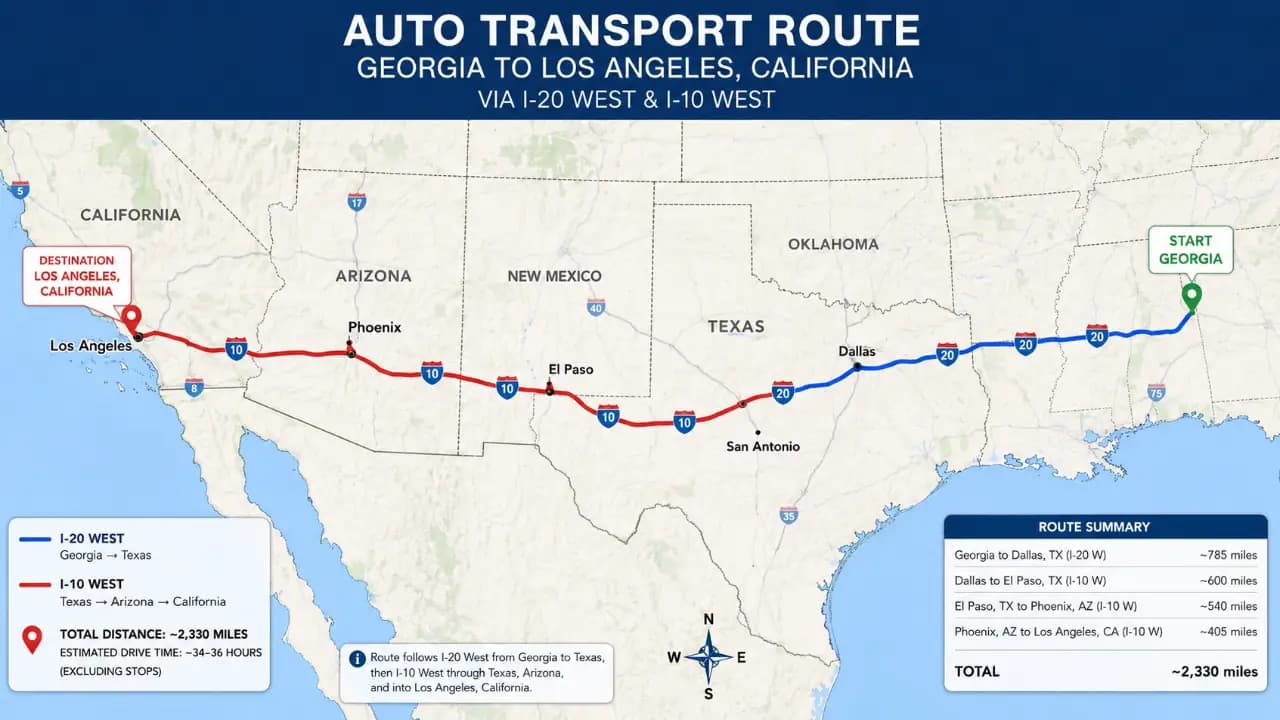
Car shipping from Georgia to California covers 2,050 to 2,400 miles depending on your cities. Standard transit runs 6 to 9 days. Most cars move on an open hauler via I-20 West out of Atlanta, then I-10 West through Texas and Arizona into Southern California. For Bay Area deliveries, carriers often cut north on I-5 or Highway 99 out of the Inland Empire.
The biggest driver on this lane is corporate relocation. Georgia tech workers, finance professionals, and entertainment industry folks move west every month. Google, Apple, and Netflix have pulled thousands of Atlanta-based employees to California campuses in the past five years. That demand keeps carrier availability high — but it also keeps prices firm during peak summer months.
Furious Auto Shipping runs this corridor weekly. We know which carriers skip the I-10 Beaumont backup near Houston and which staging yards in Ontario, California cut your delivery time by a full day. That kind of knowledge matters when your start date is fixed.
Book late in peak season and you pay 20 to 30 percent more. June, July, and August are the busiest months on this lane. Slots fill fast. If your move date is set, lock in your rate now.
The biggest driver on this lane is corporate relocation. Georgia tech workers, finance professionals, and entertainment industry folks move west every month. Google, Apple, and Netflix have pulled thousands of Atlanta-based employees to California campuses in the past five years. That demand keeps carrier availability high — but it also keeps prices firm during peak summer months.
Furious Auto Shipping runs this corridor weekly. We know which carriers skip the I-10 Beaumont backup near Houston and which staging yards in Ontario, California cut your delivery time by a full day. That kind of knowledge matters when your start date is fixed.
Book late in peak season and you pay 20 to 30 percent more. June, July, and August are the busiest months on this lane. Slots fill fast. If your move date is set, lock in your rate now.
Corporate Relocation
Atlanta has become a feeder market for California's tech, film, and finance sectors. Delta Air Lines, NCR, and Cox Enterprises have deep Georgia roots — but their employees follow opportunity west. California's entertainment industry pulls Georgia film workers after every major production wraps in Atlanta. Summer is peak season for corporate relocations tied to fiscal-year hiring cycles. Book early or expect higher rates and limited carrier windows.
Aerial Distance
Miles
(depending on city pairs)
Estimated Transit Time
Days
Common Route
I-20 West to I-10 West
Driver Availability
High — this is a top-10 national corridor with 4–6 trucks dispatched weekly
Daily Dispatches
Average Cost Ranges: Open vs. Enclosed Transport (GA to CA)
| Vehicle Type | Open Transport Cost | Enclosed Transport Cost | Why the Variance? |
|---|---|---|---|
| Sedan | $950 - $1,250 | $1,400 - $1,750 | Standard dimensions and lighter weight keep shipping costs lower on this long-distance route. |
| Small SUV | $1,050 - $1,350 | $1,550 - $1,900 | Additional height and weight slightly reduce carrier efficiency and increase pricing. |
| Large SUV | $1,200 - $1,550 | $1,750 - $2,150 | Large SUVs occupy more trailer space and may require premium loading positions. |
| Pickup Truck | $1,250 - $1,600 | $1,800 - $2,200 | Long-wheelbase trucks limit trailer capacity and often require specialized placement. |
| Luxury / Exotic | N/A - Enclosed Recommended | $2,100 - $2,800 | Enclosed transport is strongly recommended to protect high-value vehicles from road debris and weather exposure. |
Note: Note: Prices shown are market averages. Actual rates vary due to fuel surcharges, vehicle condition, exact route, and seasonal demand. Contact us for a precise quote.
I-20 West to I-10 West: The Real Bottlenecks on This 2,200-Mile Lane
Distance: ~2,050–2,400 miles
The primary corridor for Georgia to California auto transport is straightforward on paper. You leave Atlanta on I-20 West. You cross Alabama and Mississippi. Near Meridian, Mississippi, I-20 merges into I-20/I-59 briefly before splitting again. You stay on I-20 through Jackson, then hit the Texas state line east of Dallas.
In Dallas, I-20 ends. Carriers merge onto I-10 West in the Odessa-Midland area of West Texas. This is where the route opens up. West Texas has almost no traffic. Drivers make excellent time through El Paso and into New Mexico and Arizona.
The Tucson-to-Phoenix stretch on I-10 is fast. But the Banning Pass near Palm Springs is where things slow down again. High desert winds through the San Gorgonio Pass regularly delay haulers carrying tall loads. Drivers time this stretch for early morning or evening to avoid gusts above 40 mph.
For Bay Area deliveries, carriers exit I-10 at the I-15 North interchange near Ontario, California. They run I-15 North to I-210 West or Highway 99 North into the Central Valley, then cut west on I-580 or I-205 into the Bay. This adds roughly 6 to 8 hours to a Southern California delivery time.
Total driven route: approximately 2,100 to 2,350 miles depending on final delivery points. Drivers legally run 500 miles per day maximum under HOS federal rules. That math gives you a 5 to 7 day driving window — plus one day buffer for pickup and final delivery coordination.
The Open Stretch: I-20 Through Alabama and Mississippi
From Atlanta west to the Mississippi-Louisiana border, I-20 runs clean. No major metro traffic after Birmingham's I-459 interchange. Drivers make strong time here and often bank miles for the slower Texas sections ahead.
The Dallas Merge and West Texas Grind
Dallas traffic on I-20 near I-635 is brutal during rush hours — 7 to 9 AM and 4 to 7 PM. Experienced carriers time this stretch for overnight or early morning passage. Once past Odessa on I-10, the route clears completely.
The Banning Pass Wind Delay — San Gorgonio to Ontario
The final 80 miles into the LA Basin through the Banning Pass on I-10 can hold a hauler for hours. Sustained gusts above 50 mph trigger CHP wind advisories. Carriers with tall enclosed trailers are most affected. Budget an extra half-day buffer for LA deliveries in winter months.
The I-10 Bait-and-Switch: How This Corridor Gets Targeted Every Summer
The Georgia to California corridor attracts a specific scam. Brokers know this lane stays busy all summer. They lowball quotes online — sometimes $200 to $300 below real market rates — to grab your deposit. Once your car is loaded onto the hauler, the driver claims a fuel surcharge or oversize fee. You pay it or your car sits in a Texas truck yard. Warning: If a quote for a sedan comes in under $800 on this route, something is wrong. Real market rates on this corridor start at $900 for open transport. Always verify the carrier's MC number at FMCSA.dot.gov before signing anything. Furious Auto Shipping gives you the carrier name, MC number, and truck number 24 hours before pickup — no surprises at your door.
Red Flag
Warning: If a quote looks too good to be true on this corridor, verify the broker's MC number and bond status at FMCSA.dot.gov before paying anything.
Atlanta Perimeter Pickups vs. LA Basin Deliveries — Two Different Problems
Georgia Pickups: Atlanta is the main origin point. Most addresses inside the I-285 perimeter are door-to-door accessible. Midtown Atlanta and Buckhead have narrow residential streets — some drivers stage in commercial lots off Piedmont Road or Peachtree Industrial Blvd and walk the paperwork to your door. Georgia uses Peach Pass for electronic tolling on I-85, GA-400, and I-75. Savannah and Augusta pickups are straightforward — wide streets, easy access. Fort Stewart in Hinesville requires gate coordination 48 to 72 hours in advance with your Base Access Pass. Moody AFB in Valdosta follows the same protocol. For both bases, the carrier needs your sponsor's information and a copy of your PCS orders before scheduling.
California Deliveries: Los Angeles deliveries in the downtown Spring Street corridor and Venice Beach are the hardest in the state. A 10-car open hauler physically cannot turn around on Spring Street. Carriers stage at the Home Depot on W. Pico Blvd — about 2 miles from most DTLA addresses. West Hollywood's residential canyons above Sunset Strip are equally tight. San Francisco deliveries in Pacific Heights, Nob Hill, and the Castro require terminal meets. Carriers stage at the Home Depot on Bayshore Blvd near I-280 — about 3 miles from most SF addresses. Bay Area deliveries add 6 to 8 hours to transit time versus LA. California uses FasTrak for tolls on the Bay Bridge and most SoCal express lanes.
The Seamless Auto Transport Process
From Georgia to California
We have refined our process to be as simple and transparent as possible. Here's a step-by-step overview of how we handle your shipment:
Get Your Free Quote
Start by filling out our easy online quote form. Provide basic information about your vehicle, the pickup location in Georgia, and the delivery location in California. Our team will quickly provide a competitive and transparent quote with no hidden fees.
Schedule Your Shipment
Once you accept the quote, a dedicated transport coordinator will work with you to schedule the pickup. We strive to provide flexible pickup windows that align with your schedule.
Vehicle Preparation
Before pickup, we recommend a few simple steps to prepare your vehicle. We provide a detailed checklist to ensure a smooth transition, including checking fluid levels, removing personal items, and leaving a quarter tank of gas.
The Pickup
A professional, fully insured driver will arrive at your designated location in Georgia. Together, you will conduct a thorough inspection of the vehicle and document its current condition on a Bill of Lading. This document is your record and protection.
Secure Transit
Your vehicle is loaded onto the carrier and begins its journey to California. We provide real-time tracking and updates, allowing you to monitor your vehicle's progress and stay informed throughout the transport.
The Delivery
The driver will contact you as they approach the delivery location in California. At the time of delivery, you will perform a final inspection of your vehicle and sign the Bill of Lading to confirm its condition upon arrival.
Ready to Ship Your Vehicle from Georgia to California?
Get your free quote today and experience professional auto transport service with competitive rates and excellent customer support.
What Does It Actually Cost to Ship a Car from Georgia to California?
The car shipping cost from Georgia to California typically ranges from $950 to $1,600 for open transport, depending on your vehicle type, pickup location, delivery city, and the time of year. Atlanta to Los Angeles is one of the busiest coast-to-coast lanes in the country and generally offers the most competitive pricing. Deliveries into Northern California, including San Francisco and Sacramento, usually cost slightly more due to additional mileage. Summer is the most expensive season on this route, with June through August rates often increasing by $150 to $250 because of higher demand. Enclosed transport generally adds $400 to $700 above standard open carrier pricing. Larger vehicles such as SUVs and pickup trucks cost more because they occupy additional trailer space and increase overall carrier weight. Booking at least one to two weeks in advance can help secure lower pricing and better pickup windows. For an accurate rate based on your vehicle and shipping dates, use our Vehicle Shipping Quotes.
Estimated Transit Times: Georgia to California
| Origin City | Destination City | Approx. Miles | Est. Transit Time |
|---|---|---|---|
| Atlanta, GA | Los Angeles, CA | 2,150 miles | 6 - 8 Days |
| Atlanta, GA | San Francisco, CA | 2,400 miles | 7 - 9 Days |
| Savannah, GA | Los Angeles, CA | 2,280 miles | 7 - 9 Days |
| Augusta, GA | San Diego, CA | 2,200 miles | 6 - 8 Days |
| Columbus, GA | Sacramento, CA | 2,350 miles | 7 - 9 Days |
Note: Note: These are estimated transit times for standard dispatch. Severe weather, mountain pass conditions, traffic congestion, or seasonal demand may impact actual delivery dates.
Seasonal Pricing Trends
Best Time to Ship (Cheapest)
January — corporate relocation demand bottoms out after the holidays and carrier capacity is high
Peak Season (Most Expensive)
July — peak summer corporate move season with limited carrier slots and high fuel surcharges
This route follows a corporate and student relocation calendar — summer hires start in July, new academic years start in September, and January is the true off-season.
Jan
Feb
Mar
Apr
May
Jun
Jul
Aug
Sep
Oct
Nov
Dec
Desert Heat, Mountain Wind, and Gulf Storms — What Your Car Faces on This Route
When shipping a car from Georgia to California, your car moves from the humid subtropical Southeast through the Gulf Coast corridor, across the Sonoran Desert, and into California's Mediterranean or Central Valley climate. The climate shift is dramatic — and so are the risks at each stage.
Weather Risk Factors:
- Georgia summer humidity and afternoon thunderstorms: Atlanta and south Georgia see heavy rain from June through September. Hailstorms in June and July can damage uncovered loads. Open transport is still safe — hail events are brief and localized — but timing your pickup around storm systems helps.
- Texas and Gulf Coast flooding risk: The I-10 corridor through Beaumont and Houston sits in active flood zones. Hurricane season runs June through November. A tropical system can delay a load by 2 to 4 days. Furious Auto Shipping monitors active weather events and reroutes when needed.
- Sonoran Desert heat — Arizona and inland California: Summer temperatures in the Arizona desert regularly exceed 115°F. This does not damage your car's exterior, but it can stress tires and fluids on the hauler itself. Carriers hydrate loads by planning fuel stops in shaded truck bays in Tucson and Blythe, California.
Our Recommendation:
Open transport handles this route well for 90 percent of cars. If you own a luxury vehicle above $50,000, a classic car, or an exotic, book enclosed. Enclosed on this lane runs $400 to $600 more than open — worth every dollar for a car that cannot absorb road debris from West Texas gravel roads.
100% Insured & Protected
Every carrier in our network maintains a minimum of $100,000 in cargo insurance. We verify safety ratings and insurance certificates before every dispatch.
Fully Licensed
DOT Certified
A+ Rated
Georgia Sends More Cars West Than Any Other Southeast State — Here Is Why
Georgia ranked as the top Southeast state for net outbound auto transport to California in 2023, driven by Atlanta's expanding tech sector and the state's booming film industry. Over 40 major productions shot in Georgia in 2022 alone. When those productions wrap and crew relocate back to Los Angeles, they bring their cars with them. That reverse migration alone accounts for thousands of westbound shipments annually on the I-20 to I-10 corridor.
Preparing Your Vehicle for Transport
Open vs. Enclosed Transport
Open Transport (Most Popular)
- • More affordable option
- • Faster pickup times
- • Perfect for daily drivers
- • Exposed to weather elements
Enclosed Transport (Premium)
- • Complete weather protection
- • Ideal for luxury & classic cars
- • Enhanced security
- • Premium white-glove service
Vehicle Preparation Checklist
Clean Your Vehicle
Makes inspection easier and protects the paint
Remove Personal Items
Not covered by carrier insurance
Check Fluid Levels
Ensure no leaks and proper levels
Document Condition
Take photos of all sides before pickup
Leave ¼ Tank of Gas
Reduces weight while ensuring drivability
Disable Alarms
Prevents issues during transport
Why Experienced Carriers Skip I-10 Through Houston on Fridays
Here is something most brokers will not tell you. The I-10 corridor through Houston is one of the worst freight chokepoints in the country on Friday afternoons. Experienced carriers on the Georgia to California lane leave Atlanta on Monday or Tuesday. That puts them through the Houston metro area on Wednesday or Thursday — well before the Friday crush. A carrier who leaves Atlanta on Thursday hits Houston Friday afternoon. That single scheduling mistake adds 4 to 6 hours to your delivery window. Furious Auto Shipping dispatches Georgia to California loads specifically to avoid that pattern. We time departure days around the Houston window. Most customers never know this happens. But it shows up in delivery times.
Frequently Asked Questions: Shipping to California
Common questions about Georgia to California Car Shipping
Standard transit runs 6 to 9 days on this corridor. Atlanta to Los Angeles is about 2,150 miles — at 500 miles per driving day under federal hours-of-service rules, that puts your hauler in LA in 5 to 6 driving days plus time for pickup coordination and final delivery. Bay Area deliveries add 1 to 2 days versus Southern California. Summer can add a buffer day due to carrier congestion and Houston traffic delays. Expedited dispatch is available but adds $200 to $400 to your base rate. Book early and give yourself a 2-day delivery window for flexibility.
A sedan runs $950 to $1,250 for open transport. A mid-size SUV runs $1,050 to $1,350. These are real market rates on the I-20 to I-10 corridor. In peak summer months — June through August — expect a $150 to $250 surcharge on top of the base rate. Booking in January saves you up to $250 versus a July shipment. Enclosed transport runs $400 to $600 more than open. Get a locked rate before prices move — summer slots on this lane fill by mid-May.
No, not for most cars. Open transport is fine for 90 percent of vehicles on this lane. The I-10 West Texas section does kick up loose gravel, but open haulers run this route daily without incident. Enclosed makes sense if your car is worth over $50,000, is a classic or collector vehicle, or is a luxury or exotic model you cannot afford to have touched. If you are shipping a daily driver — a Camry, an Accord, an F-150 — book open and save the $400 to $600. Spend that on your California moving expenses instead.
January and February are the cheapest months on this corridor. Corporate relocation demand drops after the holiday season and carrier availability is high. You can save $150 to $250 versus a June or July shipment on the exact same route. February is also a good window — spring corporate hires have not yet activated and carriers are actively seeking loads. Book 7 to 10 days in advance in the off-season and you can often lock in next-week pickup. Do not wait until March — spring demand starts climbing and prices follow.
Yes, you can pack up to 100 pounds in the trunk or cargo area. Items must stay below the window line so the driver can see. Personal items are not covered by the carrier's cargo insurance. Pack at your own risk.
Yes. We need to know in advance so we can send a winch-equipped truck. This adds a standard winch fee to your total. Tell us upfront — do not surprise the driver at pickup.
Book the moment you have your report date confirmed — ideally 3 to 4 weeks out. Fort Stewart to Fort Irwin or Edwards AFB runs 6 to 8 days in transit. The carrier needs 48 to 72 hours to arrange gate access at your California base. You will need to provide your sponsor's name, unit, and a copy of your PCS orders for gate clearance. If your spouse is shipping the car under a Power of Attorney, send us the POA document before dispatch. Military moves on this lane peak in June and July — book early to avoid paying the summer surcharge.
The main scam on this corridor is the lowball quote followed by a delivery-day surcharge. A broker quotes $750 for a sedan — $200 below real market rate. You pay a deposit. At pickup in Atlanta, the driver claims an oversize fee or fuel surcharge. You pay or your car does not move. Protect yourself by checking the carrier's MC number at FMCSA.dot.gov before paying anything. A legitimate carrier has an active MC number and a clean complaint record. Never pay a deposit over 20 percent of the total before pickup is confirmed. Get the driver's name and truck number 24 hours before your scheduled pickup.
Explore Related Shipping Routes
We serve major corridors across the United States
Your Car Parked in Your California Driveway — That Is the Finish Line
A cross-country move has enough stress built in. Your car should not add to it. Furious Auto Shipping handles the I-20 to I-10 corridor every week. We know the Houston timing, the Banning Pass wind window, and the LA staging points that cut your delivery by a full day. Summer slots on this lane fill by mid-May. If your move is set, now is the time to lock in your rate. Get My Locked-In Rate and have a carrier dispatched before prices climb.