Loading...

Car Shipping from Florida to California (FL to CA) 2026
2,700 miles of I-10 West — know the real cost, the real timeline, and the one booking mistake that adds $300 to your bill.
• No Credit Card Required • $0 Upfront Deposit
Loading quote form...
California's Tech and Lifestyle Pull Is Filling Westbound Carriers Every Week
Car shipping from Florida to California covers 2,650 to 2,900 miles. Transit runs 7 to 10 days on standard dispatch. This is one of the longest domestic corridors in the US — and one of the most active. Every week, Floridians relocate to Los Angeles, San Diego, and the Bay Area for tech jobs, entertainment industry work, and warmer winters with Pacific views. The route runs almost entirely on I-10 West — a flat, well-serviced corridor through the Gulf Coast states and the Sonoran Desert. Carriers love this lane. Load boards fill fast. But that also means prices move quickly when demand spikes. Furious Auto Shipping dispatches trucks on this lane every week. We know which Texas weigh stations slow drivers down. We know when El Paso backs up. We know the LA county delivery windows that most brokers miss. Book 7 to 10 days out in peak season or expect to pay 20 to 30% more. January and June are the two windows when this corridor tightens fastest. Do not wait until your lease is up to call.
Corporate Relocation
The Florida to California corridor moves three types of people. Tech workers accept offers from Google, Apple, and Salesforce and need their car in the Bay Area within two weeks. Retirees swap Atlantic Beach life for San Diego's Coronado or Palm Springs. And military families receive PCS orders to Camp Pendleton or Edwards Air Force Base. Each group faces different time pressure. All three need a carrier who knows the I-10 corridor cold. Summer months see the highest total volume. January sees the sharpest price spike. Book early regardless of which group you fall into.
Aerial Distance
Miles
(depending on city pairs)
Estimated Transit Time
Days
Common Route
I-10 West through Alabama, Mississippi, Louisiana, Texas, New Mexico, Arizona
Driver Availability
High — this is one of the busiest westbound corridors in the US, with 5–7 trucks running weekly
Daily Dispatches
Average Cost Ranges: Florida to California
| Vehicle Type | Open Transport | Enclosed Transport | Why the Difference? |
|---|---|---|---|
| Sedan (e.g., Honda Accord) | $1,050–$1,350 | $1,500–$1,850 | Sedans fit easily on open carriers — high supply keeps open rates competitive on this lane |
| Small SUV (e.g., Toyota RAV4) | $1,150–$1,450 | $1,650–$1,950 | Slightly more height and weight — minor impact on fuel cost per slot |
| Large SUV (e.g., Chevy Suburban) | $1,300–$1,600 | $1,850–$2,200 | Top-deck placement limits options — fewer carriers take these on this run |
| Pickup Truck (e.g., Ford F-150) | $1,350–$1,650 | $1,900–$2,300 | Extended cabs and long beds take two slots on some carriers — pricing reflects that |
| Luxury / Exotic | N/A — Enclosed Recommended | $2,100–$2,800 | Desert UV exposure and road debris on I-10 in Arizona make enclosed essential for high-value cars |
Note: Prices shown are market averages. Actual rates vary due to fuel surcharges and seasonal demand. Contact us for a precise quote.
I-10 West: 2,700 Miles of Opportunity and Three Serious Chokepoints
Distance: ~2,650–2,900 miles
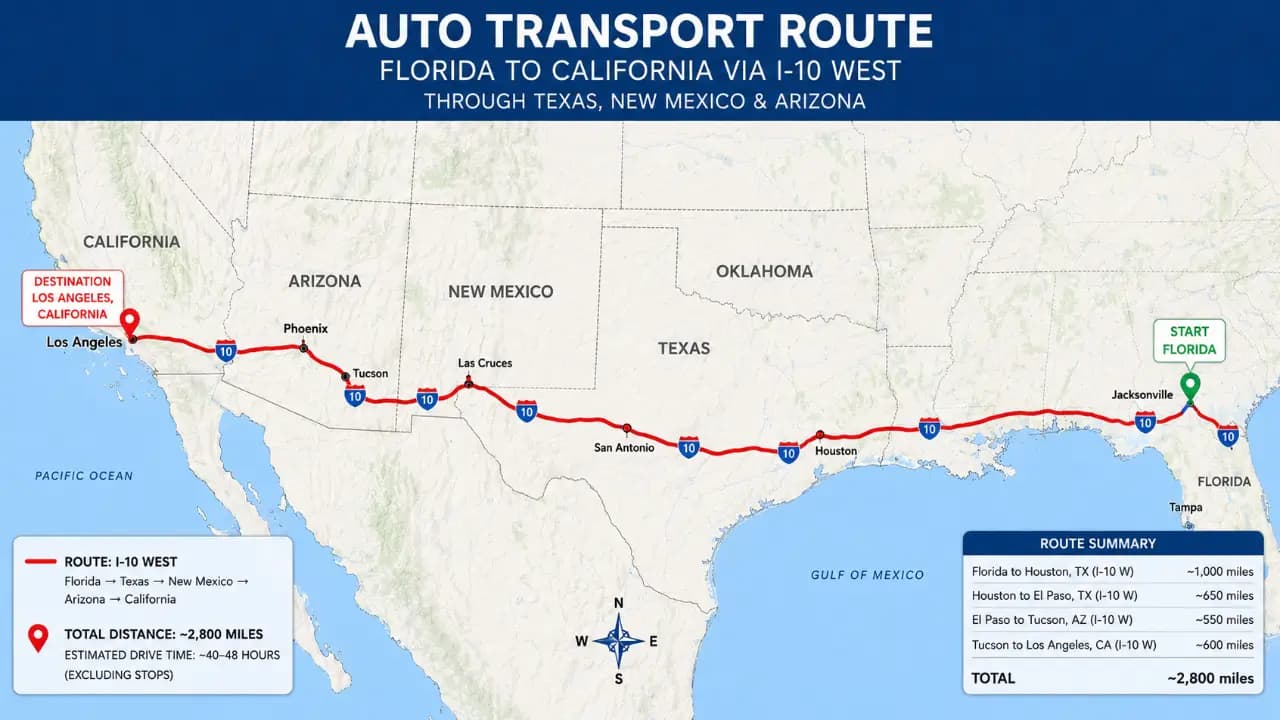
I-10 West is the spine of this corridor. Every truck leaving Jacksonville, Miami, Tampa, or Orlando merges onto it eventually. The route is remarkably flat for most of its length — great for fuel economy, good for carrier scheduling. Here is how the route breaks down in segments. From Jacksonville or Orlando, drivers run northwest on I-10 or cut across on I-75 South to I-10 at Pensacola. From Tampa, drivers typically use I-275 North to I-75 North before catching I-10 West near Lake City. The Alabama and Mississippi sections are smooth. Trucks cruise through Mobile and Biloxi without drama. New Orleans is the first real chokepoint. The I-10 elevated section through downtown floods seasonally and backs up hard on Friday afternoons. Drivers with schedule flexibility stage in Slidell, Louisiana and push through early morning. Texas is the biggest time block on the whole route. Houston traffic on I-610 and I-10 is genuinely brutal from 7 to 9am and 4 to 7pm. San Antonio is cleaner but still needs a morning window. After El Paso the route opens up. New Mexico and Arizona run fast. Los Angeles is the final chokepoint. The I-10 freeway stacks from Ontario to downtown during any weekday peak hour. Drivers delivering to the Westside use I-405 South. Bay Area deliveries peel off to I-5 North or I-580 West near Stockton. Florida to California auto transport on this corridor runs about 2,700 miles. Standard dispatch lands in 7 to 10 days.
The Gulf Coast Glide — Florida Through Louisiana
From Jacksonville to New Orleans, I-10 runs smooth and flat. Drivers cover 500 to 550 miles per day through this section without drama. Mobile, Biloxi, and Gulfport are clean passes.
The Texas Time Tax — Houston to El Paso
Texas alone adds 850 miles to the route. Houston's I-610 interchange and I-10 downtown merge back up badly on weekday mornings. Drivers who ignore the traffic window lose 2 to 3 hours right here.
The LA Last-Mile Stack — Ontario to Your Door
The I-10 West approaching Los Angeles is one of the most congested entry points in the US. Deliveries to Santa Monica, Silver Lake, and the Westside require early-morning arrival. Midday arrival adds 90 minutes minimum.
The I-10 Bait and Switch: How Brokers Low-Ball This Corridor and Double the Price at Pickup
This corridor attracts lowball brokers. Here is the pattern. A broker quotes $750 for a sedan from Miami to Los Angeles. It sounds great. You pay a deposit. Then pickup day arrives. The driver says the quote was wrong. The real rate is $1,050. Your car is on the truck. You are stuck. Warning: If a Florida to California quote is more than 20% below the market average, that is a red flag — not a deal. Verify the carrier's MC number at FMCSA.dot.gov before you pay a single dollar. Furious Auto Shipping gives you a locked-in rate. The price you see is the price you pay at delivery. No surprises at the truck door.
Red Flag
Warning: If a quote looks too good to be true on this corridor, verify the broker's MC number and bond status at FMCSA.dot.gov before paying anything.
Florida's Sprawl vs. Los Angeles County's Delivery Windows — What Your Driver Is Navigating
Florida Pickups: Florida is carrier-friendly on most doors. Miami, Orlando, Tampa, and Jacksonville all support door-to-door pickup. Miami's Brickell and Wynwood neighborhoods have tight street access — your driver may ask you to walk the car two blocks to a wider staging area. The Florida Turnpike uses SunPass. Jacksonville pickups on the Southside have clear lot access near I-95 and I-10. Orlando drivers stage near the Florida Mall on S Orange Blossom Trail when inner-city streets are blocked. Tampa pickups near Ybor City require morning windows before commercial traffic builds. Always confirm your pickup window 48 hours out — drivers plan their Texas push around Florida departure time.
California Deliveries: Los Angeles county is manageable with the right timing. Deliveries to Beverly Hills and Santa Monica work best before 9am or after 7pm. FasTrak is the California toll pass — drivers use it on the 405 and 110. San Francisco's Pacific Heights and the Castro have streets too narrow for a 10-car hauler. Your driver will meet you at the Home Depot on Bayshore Boulevard — about 2 miles from most Pacific Heights addresses. San Diego delivers cleanly to most zip codes. Camp Pendleton deliveries require prior carrier clearance at the main gate on Stuart Mesa Road — confirm this with us at booking, not on delivery day.
The Seamless Auto Transport Process
From Florida to California
We have refined our process to be as simple and transparent as possible. Here's a step-by-step overview of how we handle your shipment:
Get Your Free Quote
Start by filling out our easy online quote form. Provide basic information about your vehicle, the pickup location in Florida, and the delivery location in California. Our team will quickly provide a competitive and transparent quote with no hidden fees.
Schedule Your Shipment
Once you accept the quote, a dedicated transport coordinator will work with you to schedule the pickup. We strive to provide flexible pickup windows that align with your schedule.
Vehicle Preparation
Before pickup, we recommend a few simple steps to prepare your vehicle. We provide a detailed checklist to ensure a smooth transition, including checking fluid levels, removing personal items, and leaving a quarter tank of gas.
The Pickup
A professional, fully insured driver will arrive at your designated location in Florida. Together, you will conduct a thorough inspection of the vehicle and document its current condition on a Bill of Lading. This document is your record and protection.
Secure Transit
Your vehicle is loaded onto the carrier and begins its journey to California. We provide real-time tracking and updates, allowing you to monitor your vehicle's progress and stay informed throughout the transport.
The Delivery
The driver will contact you as they approach the delivery location in California. At the time of delivery, you will perform a final inspection of your vehicle and sign the Bill of Lading to confirm its condition upon arrival.
Ready to Ship Your Vehicle from Florida to California?
Get your free quote today and experience professional auto transport service with competitive rates and excellent customer support.
Distance Isn't the Only Price Driver on I-10 — Here's What Actually Moves the Rate
A standard sedan — Honda Accord, Toyota Camry — runs $1,050 to $1,350 for open transport from Florida to California. That is the honest market range in 2026. Most people expect less. Here is why that number is actually fair. The route is 2,700 miles. Fuel alone is a major driver cost. Then add Texas permit fees, California entry compliance, and the simple fact that westbound trucks fill faster than eastbound. Four variables move your specific price on this corridor. Pickup city matters — Miami adds $75 to $100 versus Orlando because the driver has to penetrate South Florida traffic to reach you. Delivery city matters — Bay Area delivery costs $100 to $150 more than Los Angeles because drivers have to reposition. Seasonality swings the rate by $150 to $250 between January peak and March off-peak. Booking lead time is real — book 7 days out in June and expect to pay 20 to 30% more than someone who booked 14 days out. Get the real number for your car, your cities, and your dates with our Vehicle Shipping Quotes calculator. It takes 90 seconds.
Estimated Transit Times: Florida to California
| Origin City | Destination City | Approx. Miles | Est. Transit Time |
|---|---|---|---|
| Miami, FL | Los Angeles, CA | 2,750 miles | 7–10 Days |
| Orlando, FL | San Diego, CA | 2,600 miles | 7–9 Days |
| Tampa, FL | San Francisco, CA | 2,880 miles | 8–11 Days |
| Jacksonville, FL | Los Angeles, CA | 2,500 miles | 7–9 Days |
| Tallahassee, FL | San Jose, CA | 2,700 miles | 8–10 Days |
Note: Estimated transit times for standard dispatch. Severe weather or traffic conditions may impact actual delivery dates.
Seasonal Pricing Trends
Best Time to Ship (Cheapest)
March — post-snowbird demand drops and summer corporate moves haven't started yet
Peak Season (Most Expensive)
January — westbound trucks fill fast with snowbird-adjacent migration and new-year corporate relocations
This corridor follows corporate relocation and lifestyle migration patterns — peak demand in January and June, soft demand in March through April and October through November.
Jan
Feb
Mar
Apr
May
Jun
Jul
Aug
Sep
Oct
Nov
Dec
Desert Heat, Gulf Flooding, and the One Arizona Storm That Stops Carriers Cold
When shipping a car from Florida to California, your car moves from humid subtropical air through the Gulf Coast rain belt, across the Chihuahuan and Sonoran deserts, and into Southern California's Mediterranean climate. The climate shift is dramatic — and two sections of this route carry real weather risk.
Weather Risk Factors:
- Florida hurricane season (June through November) — trucks cannot run in tropical storm conditions. Storm delays of 2 to 5 days are common when a system makes Gulf landfall near Tampa or Jacksonville.
- Monsoon flooding in Arizona and New Mexico (July through September) — I-10 near Tucson and Lordsburg, New Mexico floods quickly during monsoon events. Carriers reroute to I-8 or hold position. This adds 1 to 2 days in bad years.
- Haboob dust storms near Phoenix — these happen fast and with no warning. Visibility drops to zero. Carriers pull over and wait 30 to 90 minutes. Not dangerous long-term, but it disrupts delivery windows.
Our Recommendation:
Open transport is fine for 90% of cars on this route. The Sonoran Desert is harsh on paint if your car sits exposed for days — but it is not in transit that long. Enclosed makes sense above $50,000 in value, for classic cars, or if your car ships in July through September when haboob and monsoon risk peaks. Enclosed adds $400 to $700 to the base rate on this corridor.
100% Insured & Protected
Every carrier in our network maintains a minimum of $100,000 in cargo insurance. We verify safety ratings and insurance certificates before every dispatch.
Fully Licensed
DOT Certified
A+ Rated
Florida and California Trade More Residents Than Any Other Two-State Pair in the US
According to US Census migration data, Florida and California consistently rank among the top state-to-state migration pairs in both directions. Over 40,000 people make the Florida to California move each year. The reverse — California to Florida — is even larger. This bidirectional volume keeps carriers on this lane year-round and is why load board rates for the westbound I-10 corridor rarely go soft for more than 6 to 8 weeks at a time.
Preparing Your Vehicle for Transport
Open vs. Enclosed Transport
Open Transport (Most Popular)
- • More affordable option
- • Faster pickup times
- • Perfect for daily drivers
- • Exposed to weather elements
Enclosed Transport (Premium)
- • Complete weather protection
- • Ideal for luxury & classic cars
- • Enhanced security
- • Premium white-glove service
Vehicle Preparation Checklist
Clean Your Vehicle
Makes inspection easier and protects the paint
Remove Personal Items
Not covered by carrier insurance
Check Fluid Levels
Ensure no leaks and proper levels
Document Condition
Take photos of all sides before pickup
Leave ¼ Tank of Gas
Reduces weight while ensuring drivability
Disable Alarms
Prevents issues during transport
Why Every Experienced Driver on This Lane Stages in Deming, New Mexico
Here is something most people never hear. Experienced drivers on the Florida to California run time their push to hit El Paso during daylight hours. El Paso customs enforcement and weigh stations on I-10 near milepost 0 can add 45 to 90 minutes if a driver arrives during a shift change. The seasoned move? Stage overnight in Deming, New Mexico — about 60 miles east of El Paso. Hit the weigh station at 6am before the shift change backs things up. It saves the driver real time. That means your car arrives on the earlier end of the delivery window — not the later end. Furious Auto Shipping dispatches with drivers who know this move cold.
Frequently Asked Questions: Shipping to California
Common questions about Florida to California Car Shipping
Standard dispatch from Florida to California runs 7 to 10 days. The route covers 2,500 to 2,900 miles depending on your origin city. Miami to Los Angeles runs on the longer end — about 9 to 10 days. Jacksonville to Los Angeles tends to run 7 to 9 days because the driver enters Texas sooner. Expedited dispatch can shave 1 to 2 days off at extra cost. Summer months and January can add 1 to 2 days due to driver demand. Always build a flexible pickup window of 1 to 2 days and a flexible delivery window of the same. Carriers do not guarantee a specific delivery hour — only a date range.
A standard sedan runs $1,050 to $1,350 for open transport on this corridor in 2026. A mid-size SUV runs $1,150 to $1,450. Enclosed transport adds $400 to $600 to those figures. January is the most expensive month — prices spike 20 to 25% over average due to westbound demand. March and April are the cheapest months — you can save $150 to $250 versus a January booking. Booking less than 7 days before your pickup date in peak season adds another 20 to 30% to your rate. Get a locked-in quote before your rate window closes.
No — not for most cars. Open transport is safe for 90% of vehicles on this corridor. The I-10 route through Texas and Arizona is well-maintained. Road debris risk is low at highway speeds. Where enclosed makes a real difference is the Sonoran Desert section — intense UV and dust exposure hits luxury paint and convertible tops harder than most people expect. If your car is worth over $50,000, is a classic, or is a convertible, spend the extra $400 to $600 for enclosed. For a 2022 Honda CR-V or a 2021 Ford F-150, open transport is the right call.
March is the cheapest month on this corridor. Post-January snowbird and corporate demand clears out, and summer relocation season hasn't started yet. Carriers have open slots and prices reflect that. March rates run 12 to 15% below the annual average. April is a close second. Compared to a January booking, shipping in March can save you $150 to $250 on a sedan. The key is to still book 10 to 14 days in advance even in the off-peak window — do not assume cheap months mean instant availability.
Yes, you can pack up to 100 pounds in the trunk or cargo area. Items must stay below the window line so the driver can see. Personal items are not covered by the carrier's cargo insurance. Pack at your own risk.
Yes. We need to know in advance so we can send a winch-equipped truck. This adds a standard winch fee to your total. Tell us upfront — do not surprise the driver at pickup.
Book at least 14 days before your report date. Camp Pendleton deliveries require the carrier to be pre-cleared at the main gate on Stuart Mesa Road. That clearance process takes 3 to 5 business days. If you wait until the week before your report date, your car may arrive after you do — and you will be navigating the base without it. Give us your orders at booking and we handle the gate clearance coordination. Military PCS moves qualify for our rate-hold guarantee — your quote does not expire while your orders are being finalized.
The most common scam on this corridor is the I-10 lowball. A broker quotes $750 for a sedan. You pay a deposit. The driver shows up and says the real price is $1,100. Your car is on the truck. You have no leverage. Here is how to protect yourself. Ask for the carrier's MC number before paying anything. Verify it at FMCSA.dot.gov in 30 seconds. Never pay more than a small deposit — under $200 — before your pickup date is confirmed. Get the driver's name and truck number at least 24 hours before pickup. Any company that refuses to provide these details is one to avoid.
Explore Related Shipping Routes
We serve major corridors across the United States
Your Car Arrives. You Walk Out to a California Sunrise. Make That Day Real.
A 2,700-mile move is a lot to manage. You are handling a new lease, a new job, and a cross-country logistics puzzle all at once. Furious Auto Shipping handles the car so that puzzle has one less piece. We dispatch on this lane every week. Our rates are locked — no surprise fees at the truck door. But January and June slots fill fast. If your move is in either of those windows, today is the right day to lock your rate. Waiting two weeks in peak season adds $200 to $300 to the same booking. One click gets you a real quote with a real hold date. Get My Locked-In Rate